The Two Athenas
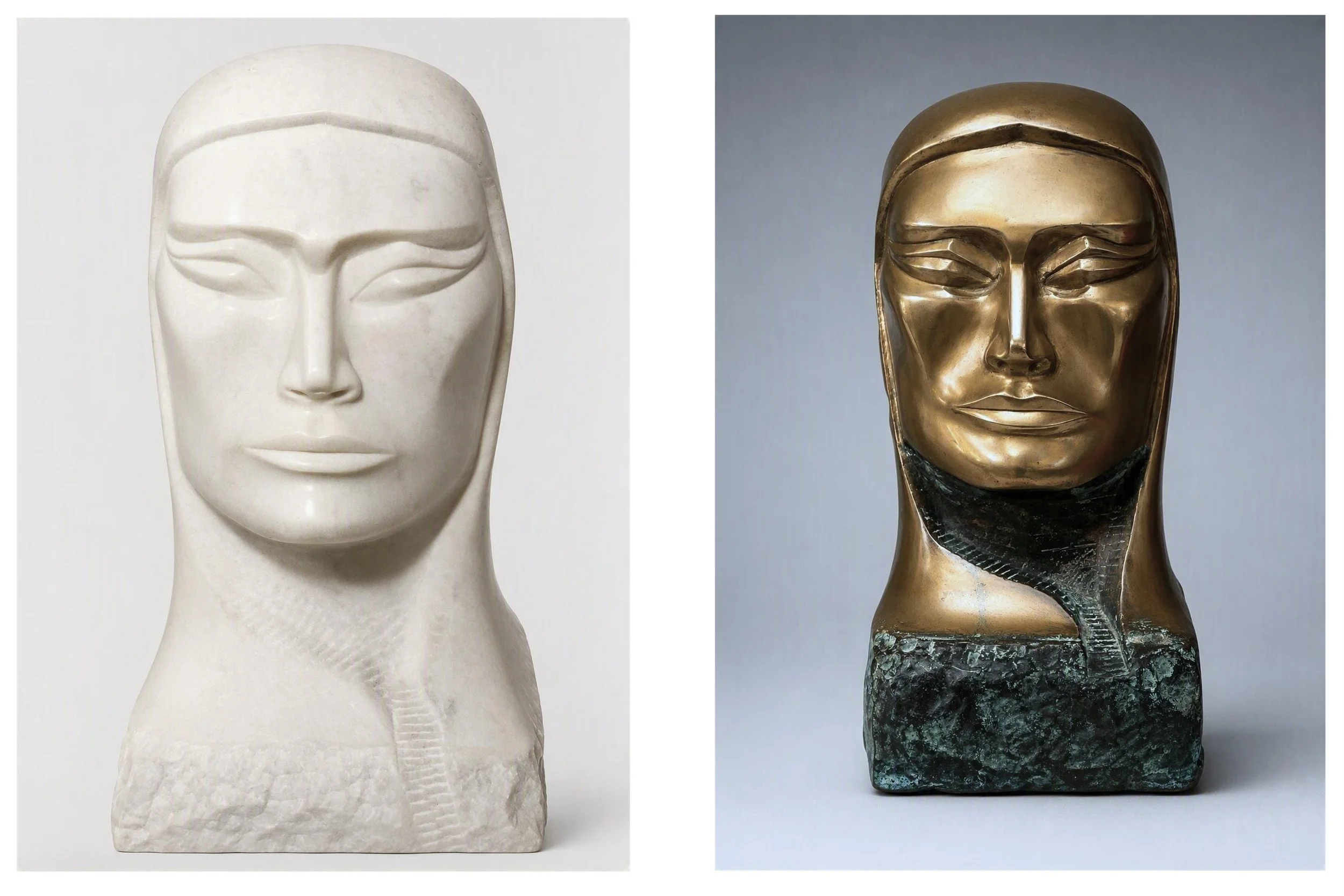
His first sculpture in marble was Athena. The work was inspired by Georgouras’ first journey to Greece, the homeland of his ancestors. During a visit to the old Acropolis Museum in Athens, the ancient Head of Athena made a profound and lasting impression on him. Later, while celebrating his thirtieth birthday on the island of Ithaka, he immersed himself in Homer's Odyssey, where Athena appears as the wise guide and protector of Odysseus throughout his epic journey. As the patron goddess of craftsmen and sculptors, Athena became a particularly fitting subject for a young artist standing at the threshold of a new life and a new vocation.
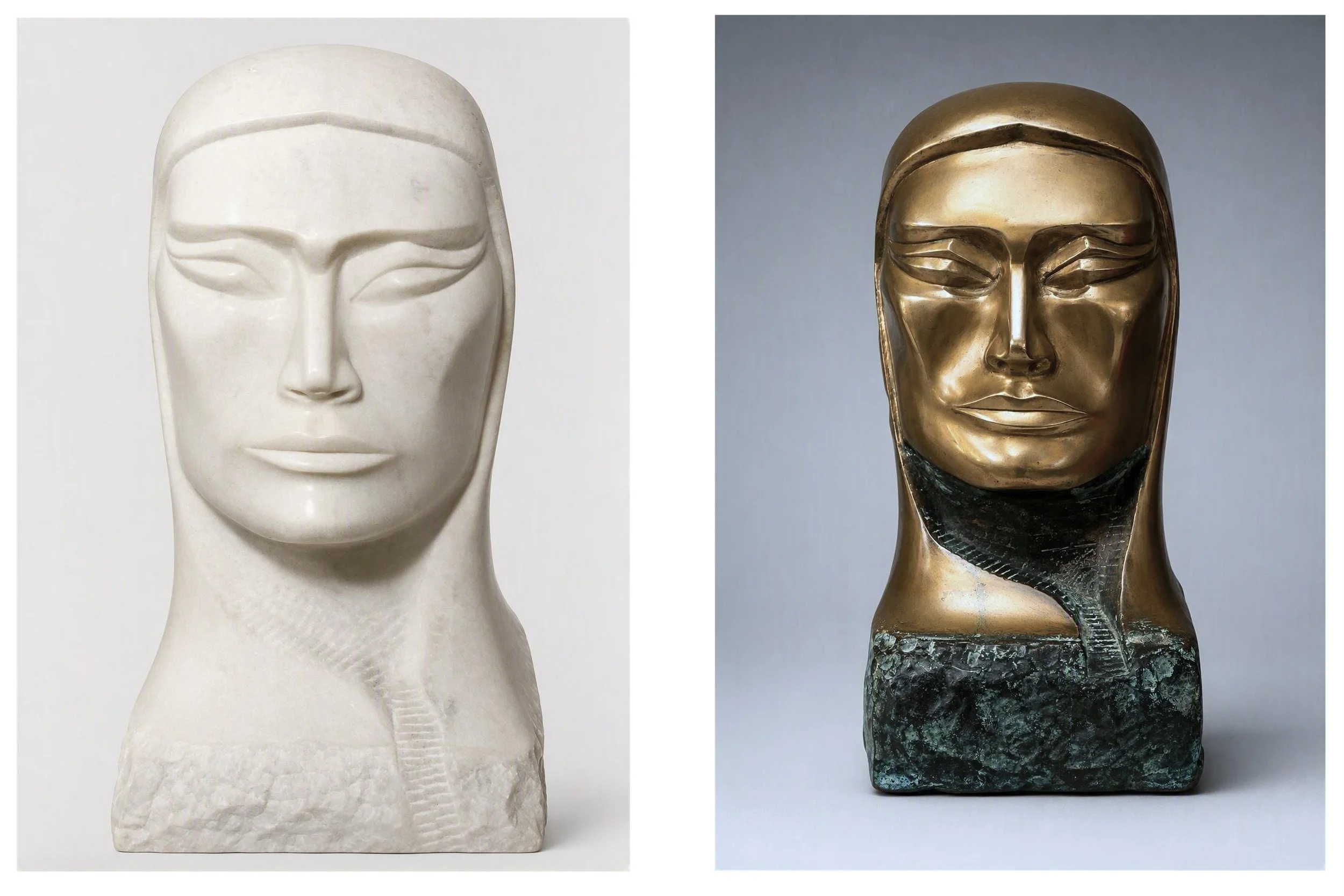
Nicholas Georgouras, Marble Athena and Bronze Athena, 1976, 40 × 20 × 18 cm
Few works in Nicholas Georgouras's career carry as much personal significance as the two sculptures now known as the Marble Athena and the Bronze Athena.
The story begins in 1976. Approaching his thirtieth year, Nicholas made a life-changing decision. He walked away from a successful business career to devote himself entirely to sculpture, choosing a path filled with uncertainty, risk and sacrifice. His motivation was simple but profound: to create without compromise.
His first sculpture in marble was Athena. The work was inspired by Nicholas's first journey to Greece, the homeland of his ancestors. During a visit to the old Acropolis Museum in Athens, the ancient Head of Athena made a profound and lasting impression on him. Later, while celebrating his thirtieth birthday on the island of Ithaka, he immersed himself in Homer's Odyssey, where Athena appears as the wise guide and protector of Odysseus throughout his epic journey. As the patron goddess of craftsmen and sculptors, Athena became a particularly fitting subject for a young artist standing at the threshold of a new life and a new vocation.
The marble sculpture embodied many of the qualities that would later define Georgouras's work: simplicity of form, balance, strength and a timeless sense of calm. More than a portrait of a mythological figure, it represented a personal commitment to the creative life.
Around 1978, the sculpture was exhibited in Nicholas's first solo exhibition at the Barry Stern Gallery in Paddington. The public responded warmly and Athena became one of the most admired works in the exhibition.
Shortly afterwards, disaster struck. The original marble sculpture was stolen.
Fortunately, Nicholas had previously made a mould of the work, allowing a bronze cast to be produced. What followed, however, was entirely unexpected. The foundry process left the bronze badly damaged, with large surface imperfections and carbuncle-like growths across parts of the casting. Rather than abandon the work, Nicholas responded directly to the problem. Out of necessity, he began carving into the bronze itself, reshaping the face and transforming the rear of the sculpture.
The result was not a restoration of the lost marble but the creation of an entirely new work.
Nicholas always regarded the two sculptures as separate pieces. The Marble Athena represented the optimism and conviction of a man beginning a new artistic journey. The Bronze Athena emerged from loss, adversity and reinvention. Though sharing a common origin, each developed its own identity, character and meaning.
The public embraced both sculptures. The Marble Athena was admired for its elegance and purity of form, while the Bronze Athena gained appreciation for its strength, individuality and remarkable history.
Today, the two Athenas stand as companion works and as powerful markers of a turning point in Nicholas Georgouras's life. Together they tell a story not only about sculpture, but about resilience, transformation and the enduring belief that creativity can turn even loss into new beginnings.
As part of this special exhibition marking the 80th anniversary of Nicholas Georgouras's birth on 10 October 1946 and 50 years since he began his sculptural journey in 1976, Thomas-Georgouras Studios is pleased to present Reflective Athenas, a limited-edition digital artwork.
Own a Limited Edition of Reflective Athenas
Edition of 10 Only
High-resolution digital artwork
Individually numbered
Certificate of Authenticity included
AUD $295
Let the Work Speak
One of the questions artists are most often asked is, "What does it mean?" The question seems straightforward enough, yet many artists have resisted answering it directly. Not because they are being elusive, but because they understand that the work itself is often the most complete answer they can offer.
I was reminded of this recently while reading about the current exhibition of painter Rita Ackermann at Hauser & Wirth in New York. Ackermann speaks of painting as a process of discovery rather than explanation. The more one attempts to define a work in words, the more one risks moving away from the experience that the work itself creates. Language can illuminate, but it can also limit. A painting operates through colour, rhythm, balance, intuition, memory and sensation. Its meaning often lies precisely in those things that words struggle to capture.
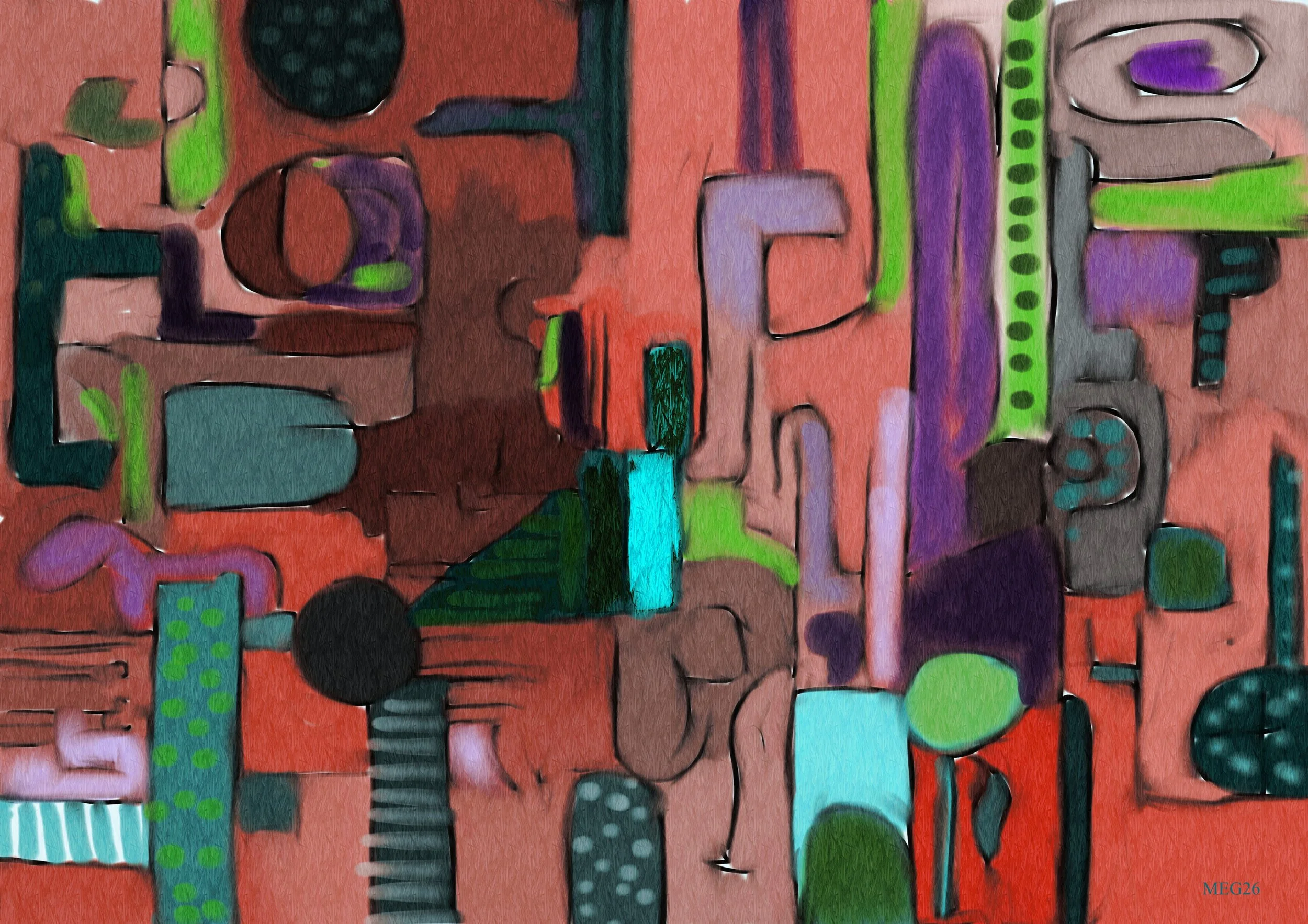
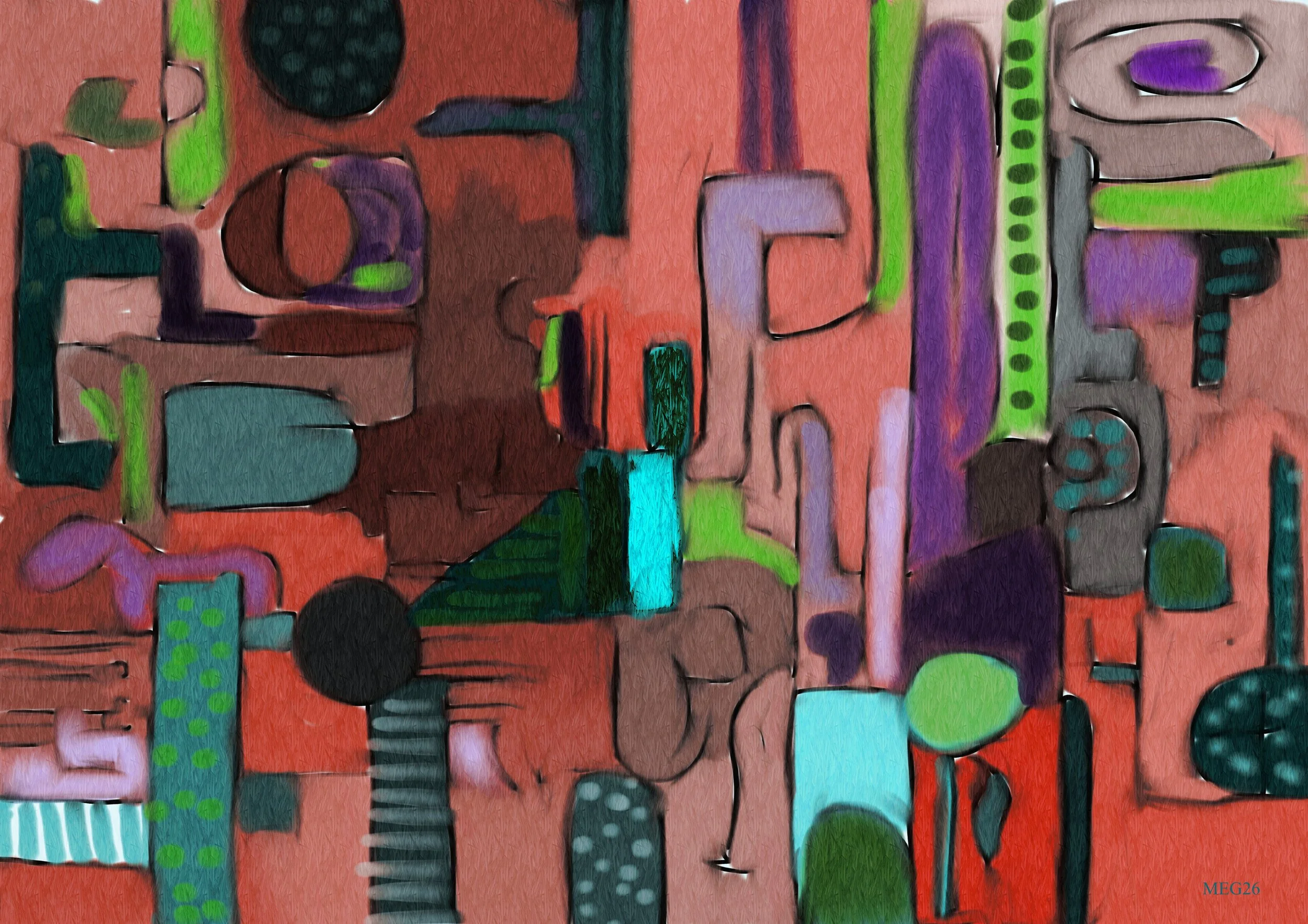
Meiko Georgouras, Red Fugue, 2026
One of the questions artists are most often asked is, "What does it mean?" The question seems straightforward enough, yet many artists have resisted answering it directly. Not because they are being elusive, but because they understand that the work itself is often the most complete answer they can offer.
I was reminded of this recently while reading about the current exhibition of painter Rita Ackermann at Hauser & Wirth in New York. Ackermann speaks of painting as a process of discovery rather than explanation. The more one attempts to define a work in words, the more one risks moving away from the experience that the work itself creates. Language can illuminate, but it can also limit. A painting operates through colour, rhythm, balance, intuition, memory and sensation. Its meaning often lies precisely in those things that words struggle to capture.
This thought feels particularly relevant when considering Scroll Variations, the new series of digital paintings by Meiko Georgouras.
For Meiko, the question of explanation carries a particular significance. Living with a disability that limits verbal communication, Meiko has long relied on visual art as the primary means through which ideas, observations and emotional experiences are expressed. The paintings do not accompany a spoken narrative; they are the narrative. Rather than explaining the work through language, Meiko speaks through colour, form and composition.
Developed from the original Scroll series of 2019, Scroll Variations revisits earlier motifs and structures, transforming them through contemporary digital processes. Inspired in part by the abstract innovations of Wassily Kandinsky, the series explores movement, repetition and change. Forms migrate from one image to another. Colours reappear in altered relationships. Suggestions of landscape, architecture, horses, music and memory emerge and dissolve. The works evolve through variation rather than description.
Looking across the series, one senses a visual conversation taking place. A shape appearing in one work may return transformed in another. A colour that dominates one composition becomes a subtle accent in the next. The paintings carry traces of previous works while continually generating new possibilities. They are connected not by a fixed narrative but by an unfolding visual logic.
Perhaps for this reason, Scroll Variations invites a different kind of viewing. Rather than searching for a definitive interpretation, the viewer is encouraged to spend time with the paintings and allow meanings to emerge gradually. The works ask to be experienced rather than decoded. They reward attention to rhythm, colour, balance and movement. Like music, they communicate through relationships rather than statements.
In this sense, the exhibition embodies the paradox that Ackermann describes. The more we try to explain a painting, the further we may move from its essential experience. Meiko's works remind us that art possesses its own language, one capable of expressing ideas that exist before words and beyond them.
Scroll Variations is not an exhibition about finding answers. It is an invitation to look, to pause and to encounter what the paintings themselves have to say.
2026
*Hauser & Wirth , 'Rita Ackermann. The Chemical Alphabet', New York, NY
American Art Catalogues, 'Rita Ackermann. Sketchbooks & Drawings, 2019 –2026', New York NY
“If you define something, what something is, it is no longer that something.
My preference is not to talk about or put words to my work.
It either works for you or doesn’t work for you and me explaining it isn’t going to make it work for you.”
Walking the Perimeter
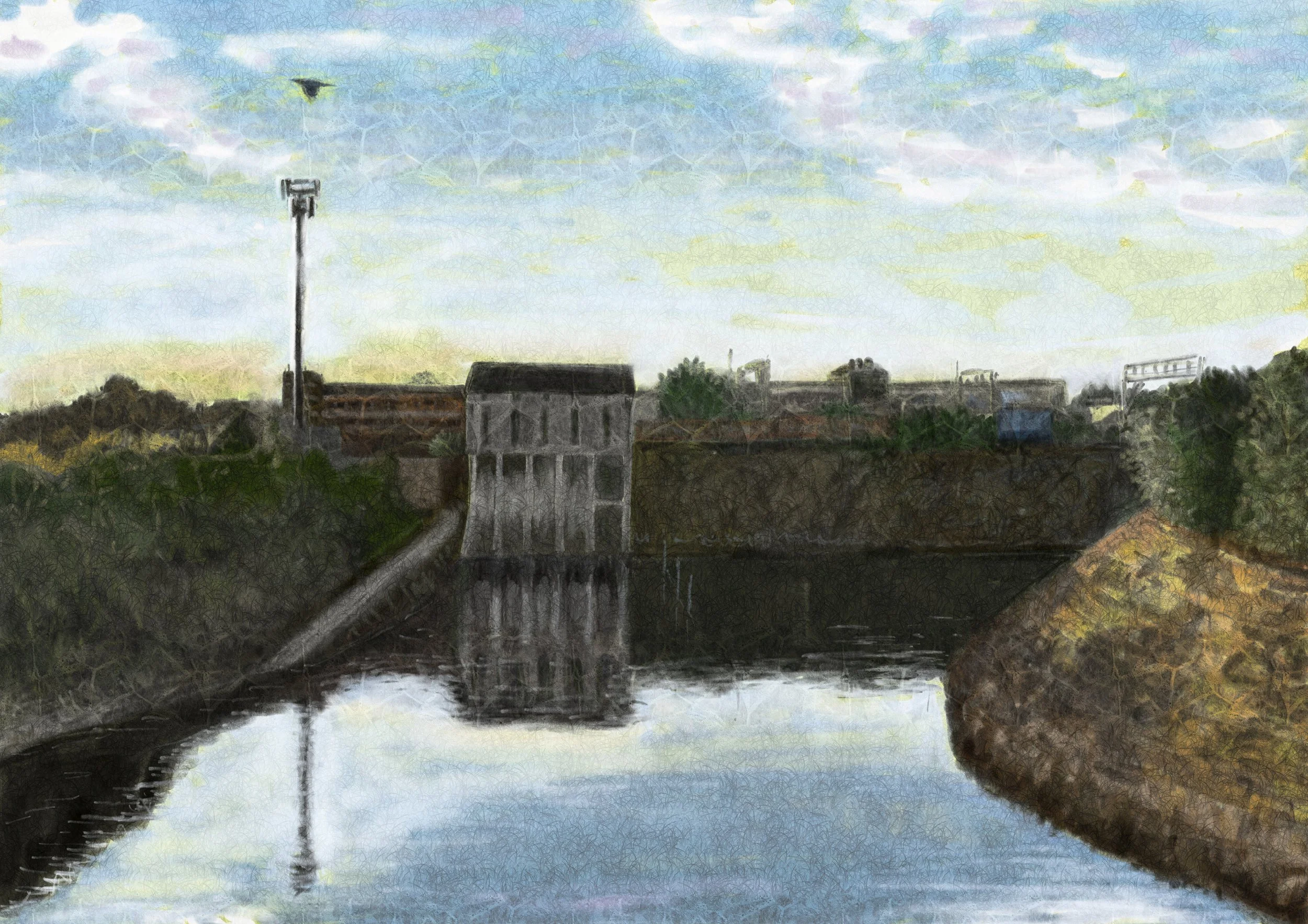
JE Thomas, The Pumping Station, Sydenham
'“It is a gentle art; know how to tramp and you know how to live,” wrote Stephen Graham in The Gentle Art of Tramping. For Graham, walking was never merely a means of getting somewhere. It was a way of entering into a richer relationship with the world, becoming "passive to the beauty of nature" and receptive to the surprises that reveal themselves along the way.
Walking the Perimeter grows from this same spirit.
The works in this exhibition are not concerned with distant horizons or celebrated landscapes. They are rooted in the ground beneath our feet, in the boundaries we traverse every day, in the streets and edges of neighbourhoods that are so familiar we are in danger of no longer seeing them.
Walking teaches us that wonder is not a destination. It is an attention.
At walking pace, the world loosens its grip on habit. A weathered fence becomes a drawing against the sky. A verge brightens with flowers planted by unseen hands. A carefully tended garden spills over onto the street. A gate repainted, a footpath swept clean, a tree given water through a long summer. Everywhere are signs of quiet devotion, small acts through which people leave traces of themselves in the landscape.
These are gestures that rarely appear in guidebooks. Yet they possess a profound beauty. They speak of care, of belonging, of an enduring faith in the value of making one's corner of the world a little more welcoming than it was the day before.
Graham understood that the pleasure of walking lies not in arrival but in what he called the "on-the-way". The road rewards those who are willing to wander, to linger, to look beyond the obvious. The ordinary, approached with patience, becomes luminous.
To walk the perimeter is therefore not simply to circumnavigate a place. It is to discover it. To notice how nature and human effort intertwine. To see beauty not as something rare and remote, but as something continually made and remade by countless everyday acts.
One need not travel to the world's great beauty spots in search of solace. The world is already offering it. In every beautiful light and forgotten glimpse of our strange world. It waits in the familiar landscape, patiently revealing itself to those who slow down enough to see.
And perhaps that is the gentle art: not merely walking through the world, but learning how to notice it.
The Necessity of Love
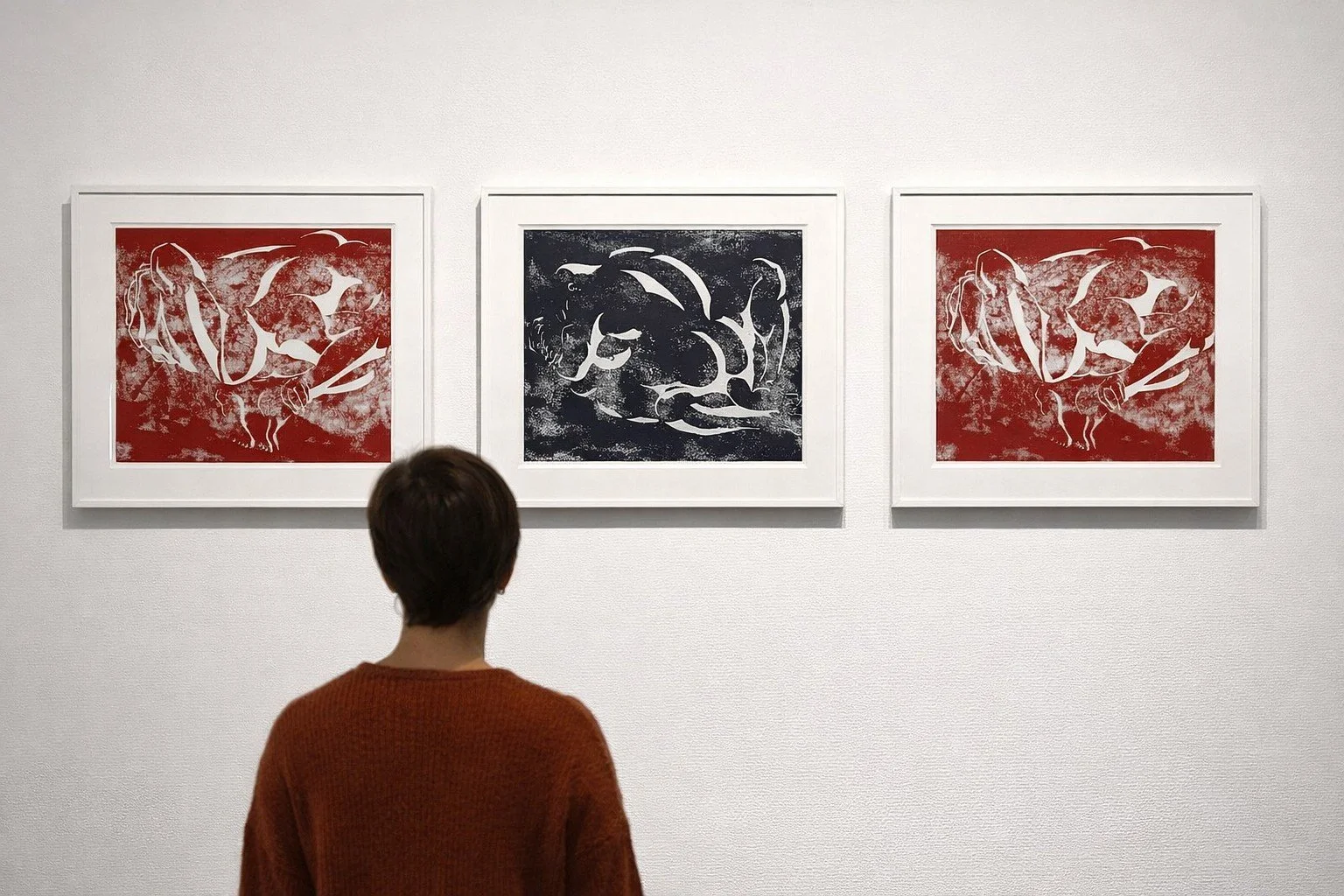
Nicholas Georgouras, “Embrace” (2008) Linocut print with red and black ink on paper
In an age increasingly defined by digital mediation, speed and distance, Nicholas Georgouras' linocuts return us to something elemental. They remind us that beneath language, technology and culture lies a more fundamental condition: our need to love, to be held, and to recognise ourselves in one another.
Created through the direct analogue process of carving into linoleum, these prints possess a physical honesty that cannot be separated from their meaning. Every cut records a decision. Every mark is irreversible. The image emerges not by addition but through removal, revealing forms that feel both ancient and immediate. It is a process that mirrors human experience itself, where identity is shaped as much by loss and vulnerability as by certainty.
The figures Georgouras created are rarely heroic. They bend, gather, embrace and endure. Reduced to their essential forms, they resist individual identity and become universal presences. They are not portraits of particular people, but reflections of the shared emotional architecture that underpins human existence.
At the heart of these works lies the necessity of love. Not as sentiment, nor as romance, but as an essential force of survival. The embrace becomes more than a gesture between two people. It is an act of protection, recognition and acceptance. It is the place where strength and vulnerability cease to be opposites.
Throughout history, artists have returned to the human figure to understand what cannot be expressed in words. Georgouras follows this tradition, stripping the body back until gesture alone carries meaning. The bowed head, the folded limbs and the enclosed form become symbols of grief, tenderness, resilience and hope. In their economy, these images speak with remarkable clarity.
Today, when images are infinitely reproducible and increasingly detached from the hand that made them, these analogue prints carry renewed significance. Their carved surfaces bear witness to the presence of the artist, reminding us that human touch is not merely a method of making, but a way of knowing the world.
Nicholas Georgouras understood that civilisation is sustained not by reason alone, but by our capacity for empathy. These prints ask us to remain open to those instinctive emotional truths that define us: compassion, care, vulnerability and love. In doing so, they quietly propose that the necessity of love is also the necessity of being fully human.
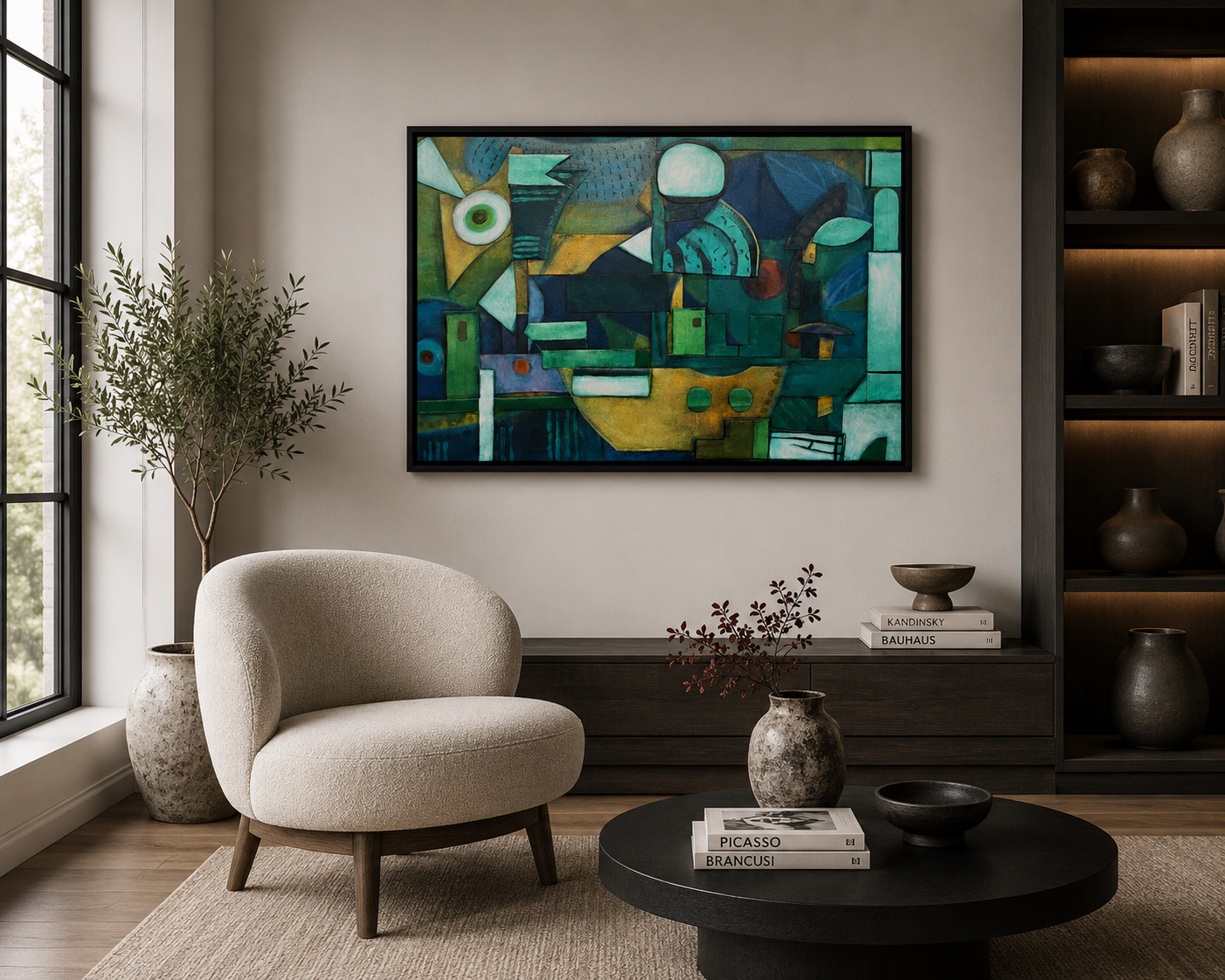
The Architecture of Survival: Disability, Thought and the Reassembly of Perception
Human experience is often fractured by trauma, illness, instability, information overload and emotional dislocation. Thought itself can become fragmented. Under these conditions, survival is not merely physical endurance, but the ability to reconstruct an inner structure capable of holding experience together without collapsing beneath it.
This is where art can become more than representation. It can become a form of cognitive and emotional architectonics.
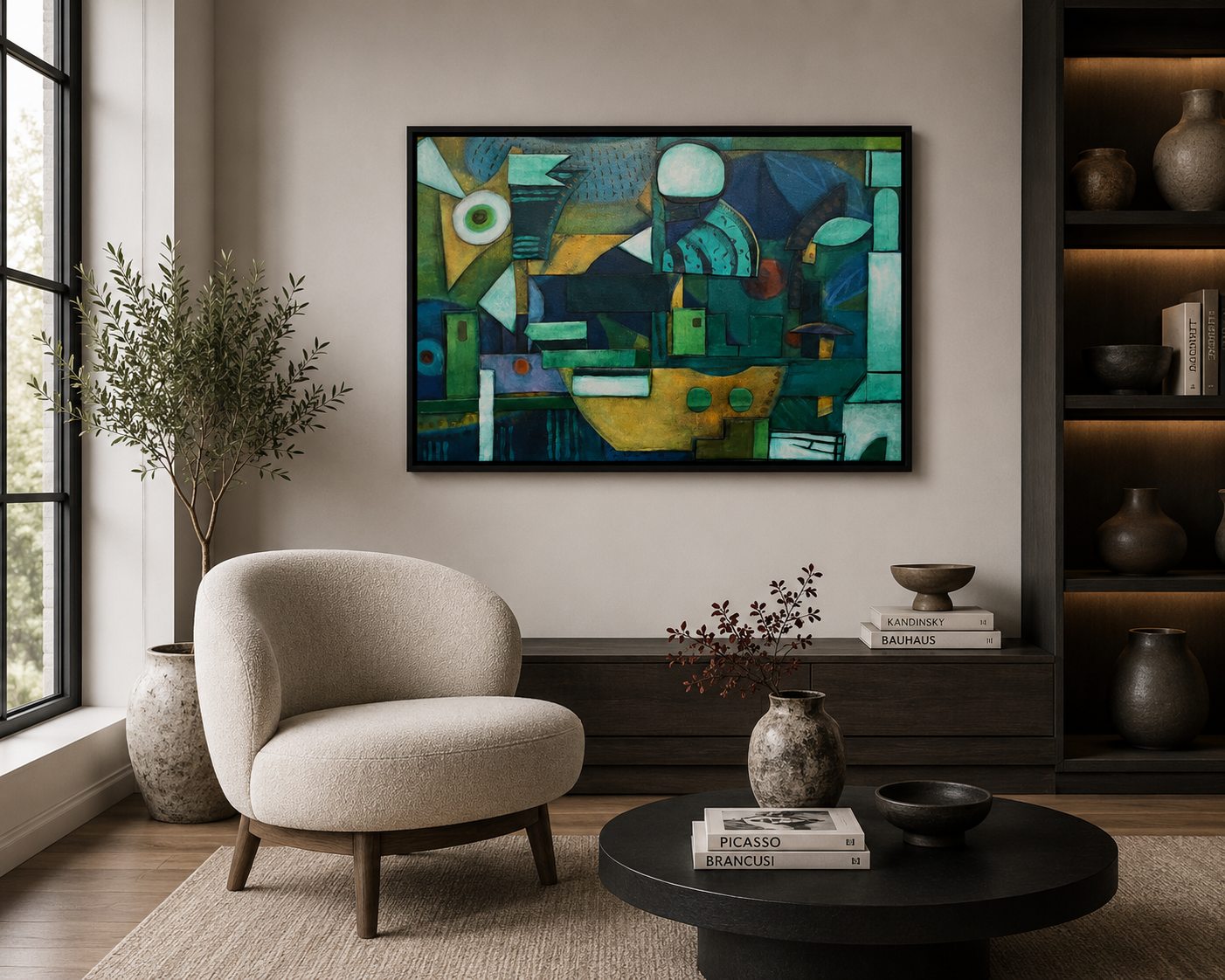
Meiko Georgouras, “Form 7”, 2026
In philosophy, the term architectonic refers to the systematic organisation of knowledge into a coherent structure. Immanuel Kant used the word to describe the way human understanding attempts to build order from the fragmented experiences of existence. Architectonics is not simply architecture in a physical sense; it is the architecture of thought itself — the framework through which perception, memory, emotion and reason are assembled into a meaningful whole.
In contemporary life, this idea has become increasingly relevant. Human experience is often fractured by trauma, illness, instability, information overload and emotional dislocation. Thought itself can become fragmented. Under these conditions, survival is not merely physical endurance, but the ability to reconstruct an inner structure capable of holding experience together without collapsing beneath it.
This is where art can become more than representation. It can become a form of cognitive and emotional architectonics.
Meiko Georgouras’ Forms series operates within this space. Through layered acrylic and collage, the paintings create systems of interconnected forms that behave like maps of consciousness in motion. Fragments of colour, geometric divisions, interrupted pathways and organic structures coexist within dynamic fields of tension and balance. The works do not present a stable image for passive viewing; rather, they construct environments through which perception itself must move.
The collage process is central to this idea. Pieces are assembled, displaced, broken apart and reconfigured. This mirrors the way human beings often rebuild themselves psychologically after disruption. The mind rarely reconstructs itself as a seamless unity. Instead, it gathers fragments — memories, emotions, symbols, routines and perceptions — and slowly creates new systems of coherence. Architectonics, in this sense, becomes an act of survival.
Yet survival alone is not the endpoint. The deeper function of architectonic thought is the possibility of thriving through reorganisation. Once fragmentation is accepted as part of existence rather than as failure, new forms of perception become possible. Flexibility replaces rigidity. Connection replaces isolation. The self becomes less like a fixed monument and more like a living structure capable of adaptation and renewal.
Within the Forms series, this process is visible in the continual negotiation between order and instability. Linear frameworks suggest scaffolding, circuitry or structural grids, while fluid biomorphic forms move through and against them like emotional or biological forces. The paintings resist closure. They remain open systems — evolving networks where meaning is constantly reconstructed through relation.
This is particularly important in the context of disability, neurological difference and lived vulnerability. Traditional models of thought often privilege stability, efficiency and fixed coherence. But human cognition is rarely so uniform. Architectonic reconstruction allows for another possibility: that fragmented perception may itself generate new forms of insight, sensitivity and creative organisation. What appears broken can become the basis for entirely new structures of understanding.
The Forms paintings embody this principle visually. They are not images of defeat or restoration in any sentimental sense. Instead, they operate as living diagrams of adaptation. Colour becomes energy. Line becomes navigation. Fragmentation becomes structure. The paintings suggest that consciousness itself is not static but continuously assembling and reassembling its relationship to reality.
In this way, architectonics is not merely a philosophical concept. It becomes an existential practice — the ongoing work of building frameworks capable of sustaining meaning, imagination and life itself. Through abstraction and collage, Meiko Georgouras transforms this process into visual form, creating works that invite viewers to reconsider how perception, memory and resilience are constructed from within.
The Forms series ultimately proposes that thriving is not the achievement of perfect order, but the ability to continually reshape one’s inner architecture in response to the changing conditions of existence.
Passage Without Fear
The Book of Psalms has always occupied a singular place in human culture; not as doctrine, but as a companion. It does not argue its way into belief; it speaks from within experience. Across centuries, it has remained one of the few texts that meets people exactly where they are: in grief, in awe, in terror, in gratitude. It is not a linear theology but a cyclical one, returning again and again to the same elemental truth; that the passage through life, and ultimately through death, need not be governed by fear.
What makes the Psalms enduring is their emotional honesty. They do not conceal anguish or tidy suffering into resolution. Instead, they articulate the full spectrum of human vulnerability: abandonment, longing, despair, and fragile hope. In doing so, they provide something more powerful than answers; they offer language. And language, in moments of extremity, becomes a form of structure. To speak fear is already to begin moving through it.
Historically, the Psalms have accompanied individuals and communities at the threshold points of existence: exile, war, illness, mourning. They have been sung in temples, whispered at bedsides, carried into prisons, and recited in moments before death. Their persistence across time suggests not just religious significance, but psychological necessity. They function as a map; not of events, but of interior states. They chart a movement from fragmentation toward coherence, from isolation toward presence.
The Psalm Series enters into this lineage, not as illustration but as embodiment. These paintings do not depict biblical scenes; they translate the experiential core of the Psalms into visual form. Where the text gives voice, the paintings give structure to silence. They operate in the space before and beyond words; where fear, memory, and transcendence intermingle.
Across the series, the human figure often appears suspended between dissolution and emergence. Forms are fragmented, layered, and reconstituted, echoing the instability of identity under pressure. There is no fixed ground. Instead, fields of colour and line function as psychological terrains; at times turbulent, at times luminous. The compositions resist resolution, yet they do not collapse into chaos. There is always a counterforce at work: a rhythm, a pull toward integration.
This tension is crucial. The Psalms themselves do not eliminate fear; they transform the relationship to it. “I will fear no evil” is not a denial of danger, but a reorientation of perception. Fear becomes something that can be held within a larger field of meaning. The Psalm Series mirrors this shift. Darkness is present, often overwhelming, but it is never absolute. Light does not erase it; it coexists, pressing through, reconfiguring the space.
The context from which these works arise gives them additional weight. They are shaped by prolonged encounters with illness, care, and the gradual erosion of certainty. In such conditions, fear is not abstract; it is lived, daily, cumulative. The Psalms, in this light, are not distant texts but active companions. The paintings extend that companionship into a shared visual space, allowing others to enter into the same negotiation between vulnerability and endurance.
What emerges is not comfort in the sentimental sense, but something more durable: a recognition that fear can be carried without being definitive. The passage through life and death is not smoothed or simplified. It remains complex, often opaque. Yet within that complexity, there is the possibility of orientation; of finding a way to move, even when clarity is absent.
The enduring relevance of the Psalms lies precisely here. They do not promise escape from suffering. They offer a way to inhabit it without being consumed. The Psalm Series takes up that task in another medium, translating ancient rhythms into contemporary form. Together, they suggest that the deepest human need is not certainty, but accompaniment; the sense that even in the most disorienting passages, one is not entirely alone.
And perhaps this is what allows fear to loosen its hold. Not because it disappears, but because it is met—spoken, seen, and carried—across time, across bodies, across forms.
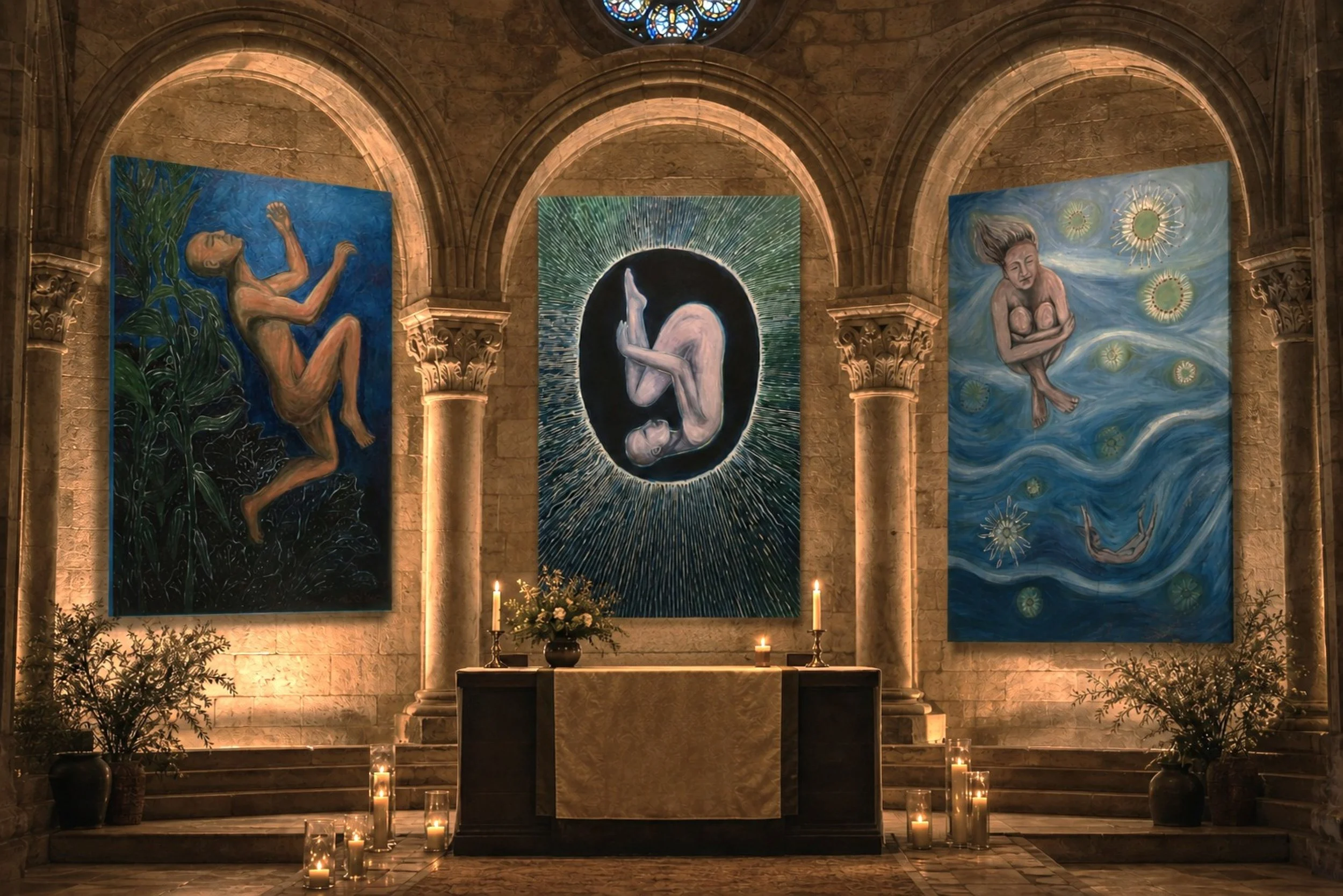
Psalm Series in a Sacred Space
Learning to look: Between a cry and a proclamation
What does it mean to really look at art? Not to glance, not to label, not to decide quickly whether you like it—but to stay with it long enough for something to shift. This question becomes especially vivid when two works are placed side by side, not to confirm each other, but to challenge the way we see.
Consider the encounter between Anakronos, the monumental granite relief by Nicholas Georgouras, and Out of the depths I cry to you, the large oil painting by Janet Elizabeth Thomas. At first glance, they seem to belong to entirely different worlds. One is carved, structured, declarative; the other is painterly, fluid, and inward. But it is precisely this difference that activates the act of looking.
Thomas’s painting draws you in quietly. A solitary figure hovers in a deep, enveloping blue, suspended between falling and rising. The body is soft, vulnerable, its gesture ambiguous—part surrender, part resistance. There is no fixed ground, no clear orientation. Instead, there is atmosphere, sensation, a sense of being submerged within one’s own interior world. The title reads like a whisper or a plea, reinforcing the feeling that this is not an image to be decoded, but an experience to be entered.
If you spend time with it, the painting begins to unfold slowly. The brushwork, the tonal shifts, the subtle presence of organic forms—these are not just aesthetic details, but carriers of feeling. You start to realise that the work is less about what is shown than about how it is felt. It resists clarity, and in doing so, it invites you to sit with uncertainty.
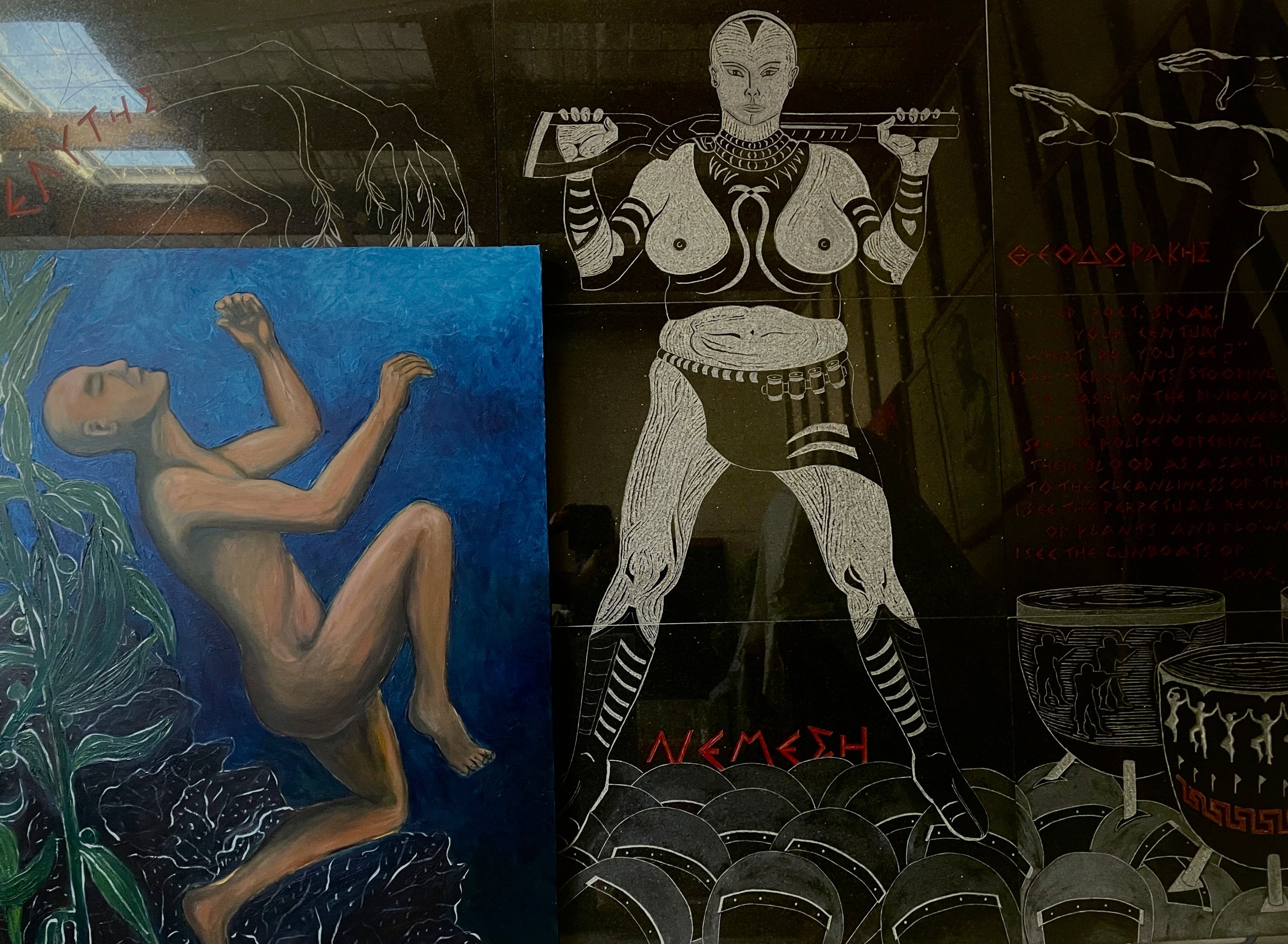
Then you turn to Anakronos.
Where Thomas’s work dissolves, Georgouras’s asserts. The central figure stands upright, frontal, commanding. Around it, a network of symbols, inscriptions, and figures unfolds across the surface with deliberate precision. The material—granite—anchors the work in permanence. Lines are incised, controlled, resistant to change. The limited palette of black, white, and red carries the weight of ritual and history, suggesting a language that is constructed rather than felt.
This is not a work that invites you inward in the same way. It confronts you. It asks to be read, interpreted, even decoded. There is a sense of system here—of meaning being built, structured, and presented. If Thomas’s painting is a cry emerging from within, Anakronos is a proclamation projected outward into the world.
Placed together, these works do something powerful. They sharpen each other. The vulnerability of Thomas’s figure becomes more pronounced in the presence of Georgouras’s authority. At the same time, the certainty of Anakronos begins to feel less absolute when seen alongside the ambiguity of the painting. What seemed fixed starts to open; what seemed fluid gains intensity.
This is where the real value of looking emerges. Not in isolating works, but in allowing them to enter into dialogue. The space between them becomes active—a site of tension, contrast, and discovery. You begin to move back and forth, not just physically, but mentally, testing your own responses against what you see.
And something else happens, something more subtle. You become aware of your own position as a viewer. Do you gravitate toward the emotional openness of the painting, or the structured authority of the relief? Do you trust what you feel, or what you can analyse? These are not questions with right answers, but they matter. They reveal how you engage with the world beyond the gallery as well.
In this sense, looking at art is not passive. It is a form of participation. The works do not complete themselves without you. Meaning is not fixed within them; it emerges through your attention, your movement, your willingness to stay with what is not immediately clear.
This is why juxtaposition matters. It disrupts the comfort of quick interpretation and replaces it with a more demanding, but more rewarding, kind of seeing. It asks you to hold two different realities at once—to recognise that art can be both an intimate expression of inner life and a constructed system of external meaning.
If you take anything from this encounter, let it be this: give yourself time. Stand in front of a work longer than feels necessary. Then look at another. Let them speak to each other, and to you. Because in that space—between a cry and a proclamation—you may begin to see not just the artworks more clearly, but your own way of seeing itself.
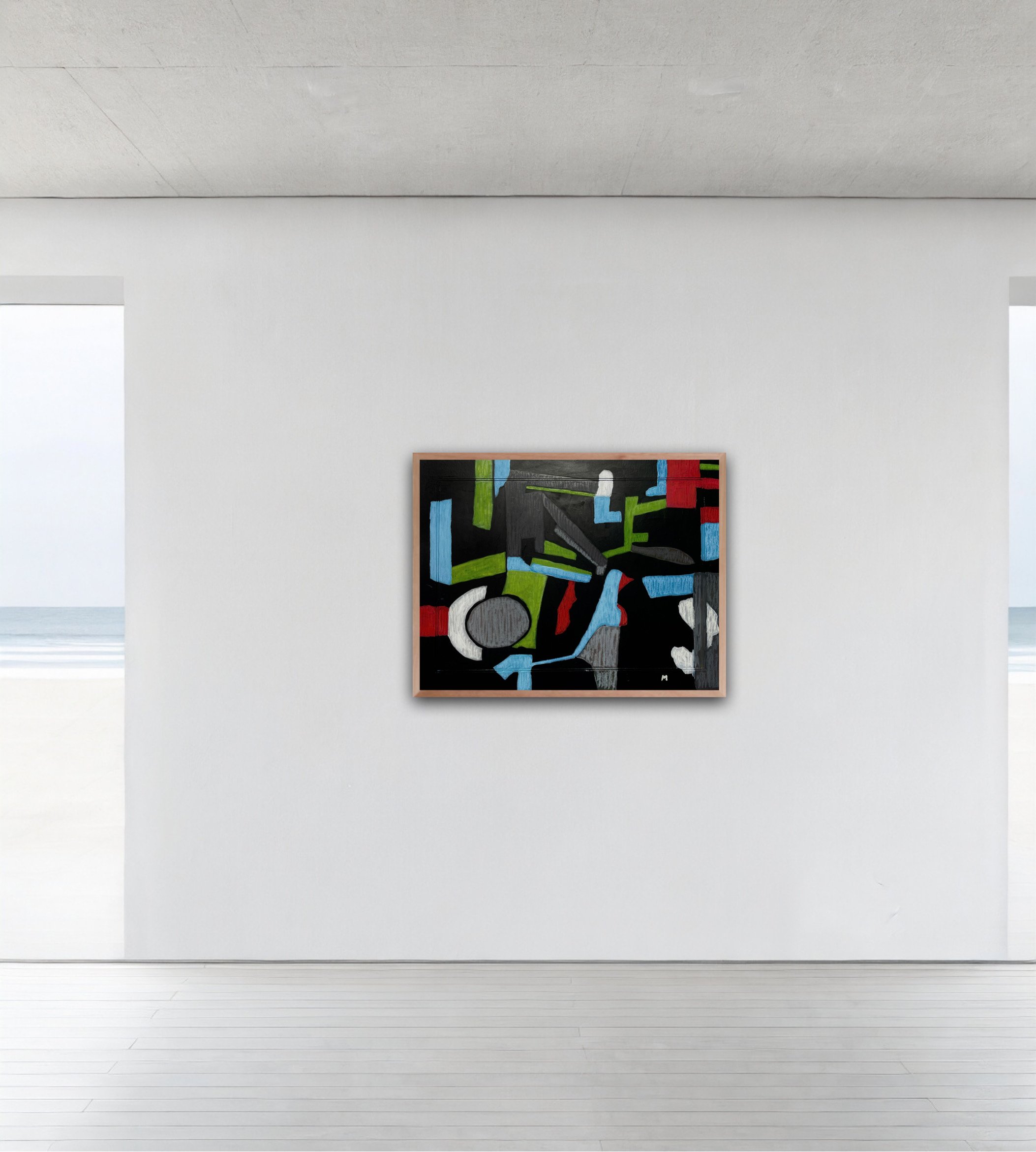
Fragments: Reassembling Meaning in a World That Tends Toward Disorder
Fragments: Art, Entropy, and the Work of Reassembling a Life
Online exhibition by Meiko Georgouras
There is a quiet law that shapes the universe: things tend to fall apart.
In physics, this tendency is known as entropy—the gradual dispersal of energy and the drift from order toward disorder. It is the reason stars cool, structures decay, and even memories fade. Systems that once held themselves together eventually loosen, their patterns blurring as energy spreads outward.
In human life we encounter a parallel process. We might call it fragmentation: the breaking of once-coherent wholes into scattered pieces. Communities fracture. Ecosystems become divided. Attention splinters under constant stimulation. Where connections weaken, coherence becomes harder to sustain.
Entropy and fragmentation describe the quiet forces that pull systems apart. As entropy rises, structure dissolves. As fragmentation spreads, relationships loosen. A fragmented forest loses species just as a fragmented community loses trust. A mind pulled in too many directions begins to resemble a physical system whose energy has dispersed beyond usefulness.
Yet this is only part of the story.
Entropy reminds us that order is not the natural default of the universe—it is something that must be created and sustained. Structure, meaning, and connection arise through effort, care, and attention. Fragmentation, likewise, does not only describe breakdown. It also signals where something new may need to be built.
Recognising these forces gives us a certain agency. If entropy pulls systems toward disorder, then the act of creating order—whether in ecosystems, communities, or works of art—becomes a meaningful human response. It is the ongoing work of holding things together.
This idea takes on a deeply personal dimension in the experience of disability.
Disability often arrives like a shift in gravity. Movements that once felt effortless grow heavy. Actions that once aligned naturally begin to scatter. Familiar patterns loosen, and the structure of daily life can feel as if it is slowly unravelling.
At first glance, this can resemble entropy in the scientific sense: a drift away from order. But human lives are not closed systems. They do not simply decay. They reorganise.
Where old abilities fall away, new forms of order begin to emerge—sometimes quietly, sometimes reluctantly, but always with a kind of intelligence shaped by lived experience rather than design. The body learns alternative pathways. The mind cultivates different strengths. Tools, technologies, and communities form a lattice that supports what biology alone cannot sustain.
What appears from the outside as loss can, from within, become a process of re-patterning—a search for a new form of coherence that acknowledges the changed terrain of the body and mind.
This is not a romanticisation of difficulty. Rather, it is a recognition of the deep adaptability of human life.
Living with disability often means learning to build coherence from pieces that no longer fit together in the ways they once did. The work of adaptation unfolds in small, daily adjustments: in the rhythms of the body, in the organisation of time, in the use of tools and supports that make participation possible.
These changes are not signs of collapse. They are signs of a system reorganising itself around reality rather than expectation.
In this sense, fragmentation is not only about breaking apart. It is also about reassembling.
The exhibition Fragments sits within this landscape of lived reorganisation. The works do not present fragmentation as failure, but as a state of becoming. Each image suggests pieces in motion—forms that hover between dissolution and reconstruction, searching for a new equilibrium.
The paintings echo the way disability reshapes a life: not by erasing what came before, but by rearranging it. Elements that once belonged to a different order return in altered relationships, forming structures that carry their own integrity.
Seen this way, the exhibition is less about fracture than about form.
It invites viewers to consider how meaning is often created not from seamlessness but from the deliberate joining of disparate parts. It suggests that beauty can emerge from interruption, and that identity can be strengthened—not diminished—through the necessity of rebuilding.
Many people who live with disability eventually discover a quiet truth: order is not something simply inherited from the past. It is something made.
It is made through adaptation.
Through community.
Through tools and technologies that extend the body’s possibilities.
Through the courage to release an old structure and trust that a new one can take shape.
This understanding resonates through Fragments. The works do not offer a single narrative of disability. Instead, they gesture toward a shared experience: the ongoing effort to create coherence in a world that often misunderstands what that effort requires.
To live with disability is, in many ways, to live among fragments.
But it is also to possess the capacity to arrange those fragments into patterns that are honest, functional, and sometimes unexpectedly beautiful.
The works in this exhibition are part of that process—visual reflections on the human act of reassembling meaning in a universe that is always, quietly, coming apart.
View the online exhibition:
Thomas‑Georgouras Studios
https://thomas-georgourasstudios.au
There is a quiet law that shapes the universe: things tend to fall apart. In physics, this tendency is known as entropy—the gradual dispersal of energy and the drift from order toward disorder. It is the reason stars cool, structures decay, and even memories fade. Systems that once held themselves together eventually loosen, their patterns blurring as energy spreads outward.In human life we encounter a parallel process. We might call it fragmentation: the breaking of once-coherent wholes into scattered pieces. Communities fracture. Ecosystems become divided. Attention splinters under constant stimulation. Where connections weaken, coherence becomes harder to sustain.
Entropy and fragmentation describe the quiet forces that pull systems apart. As entropy rises, structure dissolves. As fragmentation spreads, relationships loosen. A fragmented forest loses species just as a fragmented community loses trust. A mind pulled in too many directions begins to resemble a physical system whose energy has dispersed beyond usefulness. Yet this is only part of the story. Entropy reminds us that order is not the natural default of the universe—it is something that must be created and sustained. Structure, meaning, and connection arise through effort, care, and attention. Fragmentation, likewise, does not only describe breakdown. It also signals where something new may need to be built.
Recognising these forces gives us a certain agency. If entropy pulls systems toward disorder, then the act of creating order—whether in ecosystems, communities, or works of art—becomes a meaningful human response. It is the ongoing work of holding things together. This idea takes on a deeply personal dimension in the experience of disability. Disability often arrives like a shift in gravity. Movements that once felt effortless grow heavy. Actions that once aligned naturally begin to scatter. Familiar patterns loosen, and the structure of daily life can feel as if it is slowly unravelling.
At first glance, this can resemble entropy in the scientific sense: a drift away from order. But human lives are not closed systems. They do not simply decay. They reorganise. Where old abilities fall away, new forms of order begin to emerge—sometimes quietly, sometimes reluctantly, but always with a kind of intelligence shaped by lived experience rather than design. The body learns alternative pathways. The mind cultivates different strengths. Tools, technologies, and communities form a lattice that supports what biology alone cannot sustain. What appears from the outside as loss can, from within, become a process of re-patterning—a search for a new form of coherence that acknowledges the changed terrain of the body and mind. This is not a romanticisation of difficulty. Rather, it is a recognition of the deep adaptability of human life.
Living with disability often means learning to build coherence from pieces that no longer fit together in the ways they once did. The work of adaptation unfolds in small, daily adjustments: in the rhythms of the body, in the organisation of time, in the use of tools and supports that make participation possible. These changes are not signs of collapse. They are signs of a system reorganising itself around reality rather than expectation. In this sense, fragmentation is not only about breaking apart. It is also about reassembling.
The exhibition Fragments sits within this landscape of lived reorganisation. The works do not present fragmentation as failure, but as a state of becoming. Each image suggests pieces in motion—forms that hover between dissolution and reconstruction, searching for a new equilibrium. The paintings echo the way disability reshapes a life: not by erasing what came before, but by rearranging it. Elements that once belonged to a different order return in altered relationships, forming structures that carry their own integrity. Seen this way, the exhibition is less about fracture than about form. It invites viewers to consider how meaning is often created not from seamlessness but from the deliberate joining of disparate parts. It suggests that beauty can emerge from interruption, and that identity can be strengthened—not diminished—through the necessity of rebuilding.
Many people who live with disability eventually discover a quiet truth: order is not something simply inherited from the past. It is something made. It is made through adaptation.
Through community. Through tools and technologies that extend the body’s possibilities. Through the courage to release an old structure and trust that a new one can take shape. This understanding resonates through Fragments. The works do not offer a single narrative of disability. Instead, they gesture toward a shared experience: the ongoing effort to create coherence in a world that often misunderstands what that effort requires.
To live with disability is, in many ways, to live among fragments. But it is also to possess the capacity to arrange those fragments into patterns that are honest, functional, and sometimes unexpectedly beautiful. The works in this exhibition are part of that process—visual reflections on the human act of reassembling meaning in a universe that is always, quietly, coming apart.
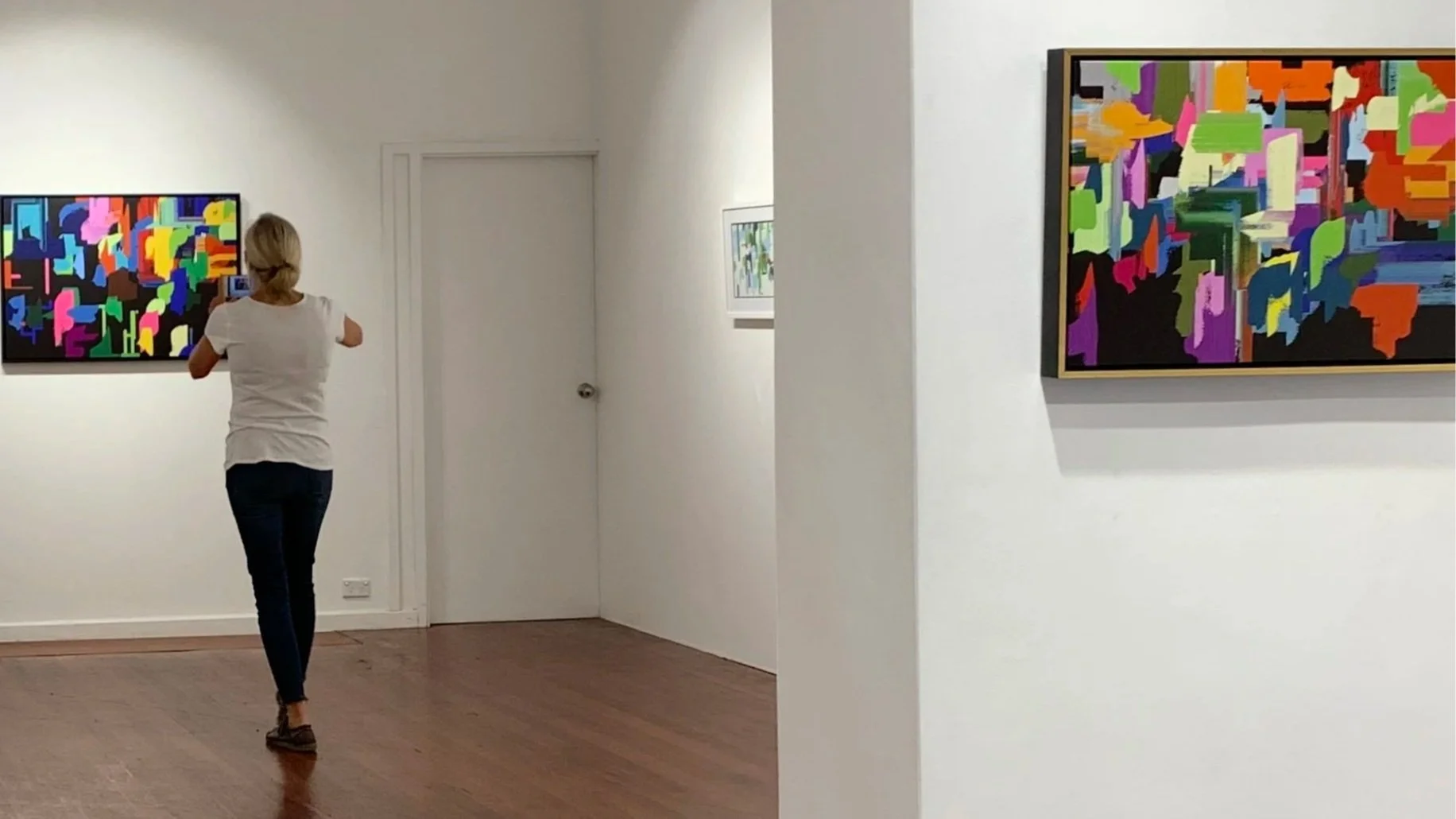
Why Looking at Art Matters: Encountering Other Minds in a Gallery
Why Looking at Art Matters: Encountering Other Minds in a Gallery
Looking at art is more than a visual experience—it is a way of encountering another mind. This essay explores why viewing art in galleries, museums, and online collections allows us to discover new ways of seeing and deepens the connection between artists and viewers.
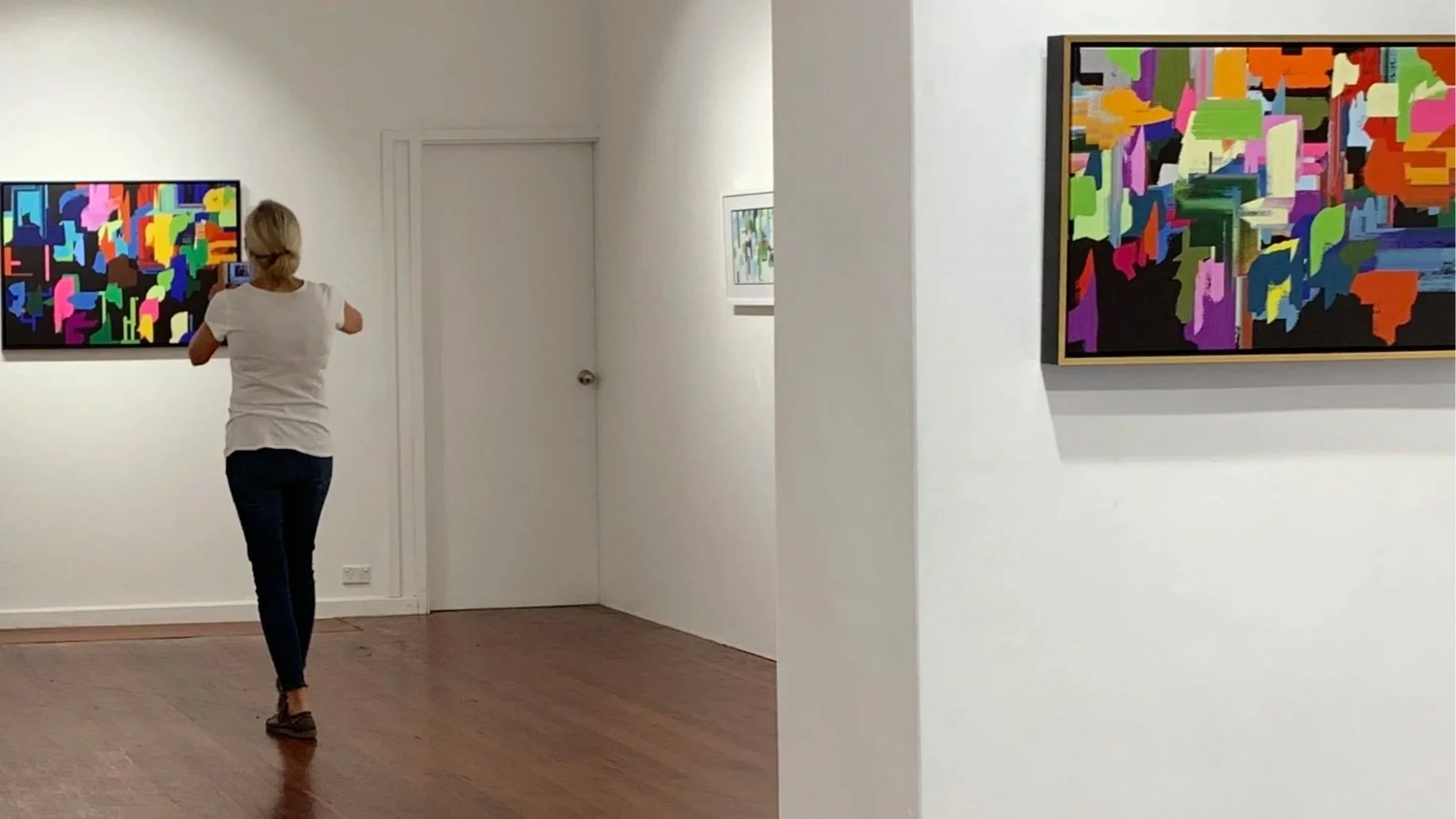
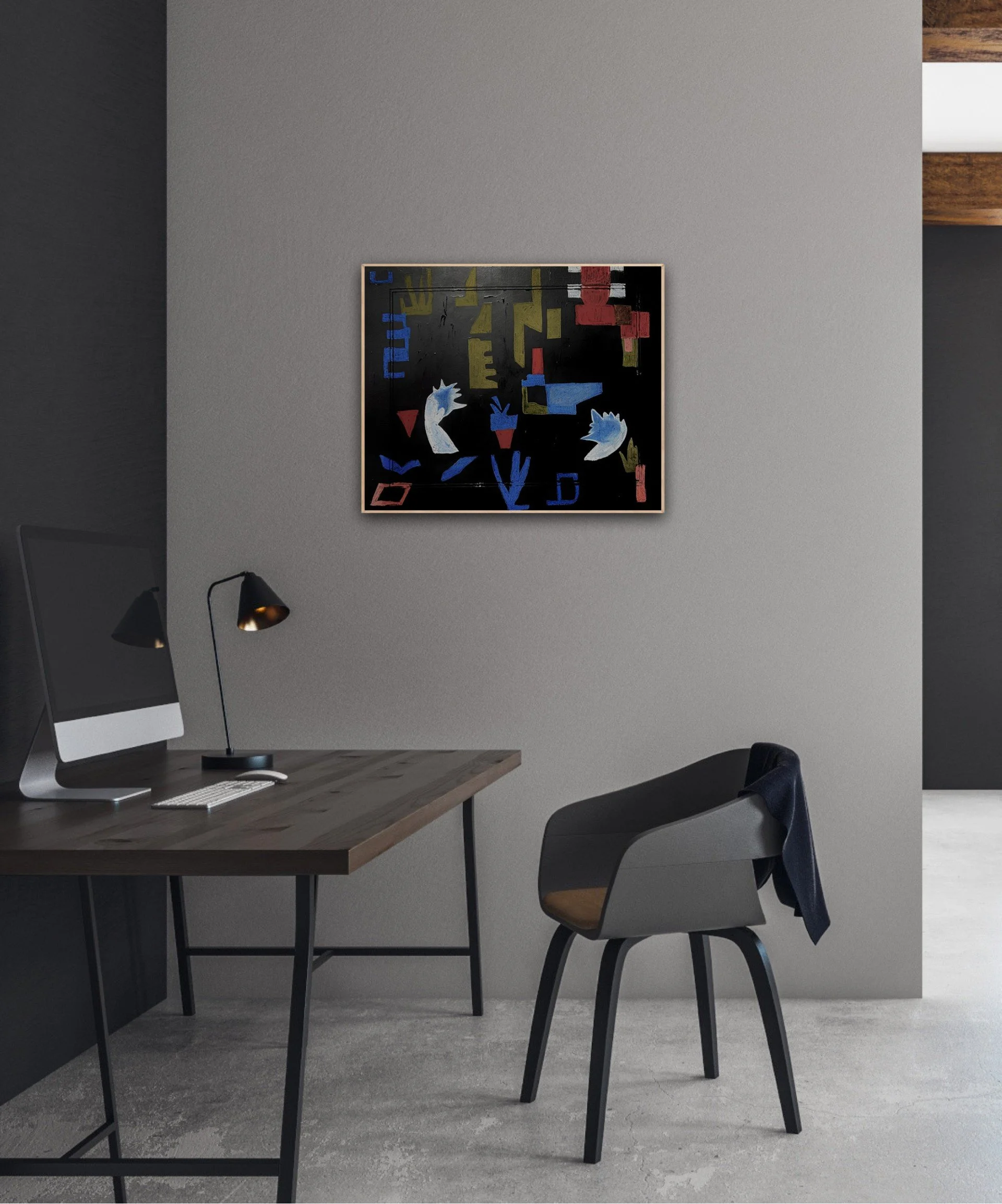
A person viewing Meiko Georgouras’ Scroll exhibition from 2019
Art as a Meeting Between Minds
When we look at a work of art, something unusual happens. We are not simply looking at colour, form, or subject matter—we are looking into another mind. Every artwork is the visible trace of a consciousness. Behind every line, colour, and compositional decision lies an act of attention: a person deciding what matters, what should be emphasised, and what should disappear. A painting, drawing, or digital image becomes a record of these decisions. To stand before a work of art is therefore to encounter the structure of another person’s perception.This is one reason art galleries have always held such fascination. Moving through a gallery is not only a visual experience; it is an encounter with many different ways of seeing the world. Each work represents a particular mind organising experience into form. One artist may construct a calm geometry of colour and space, while another pursues movement, tension, or psychological intensity. As viewers move from one work to another, they pass through a series of distinct mental landscapes.
The Unique Experience of Viewing Visual Art
Unlike literature or music, visual art offers this encounter almost instantly. A novel unfolds over time, and music must be heard sequentially. A painting or drawing presents its structure all at once.In a single glance we begin to sense the rhythm of lines, the balance of shapes, and the emotional weight of colour. Even before we consciously analyse what we are seeing, we intuit the artist’s ordering of the world.Looking at art therefore becomes a form of discovery. We are not only discovering images—we are discovering perspectives. Each artwork quietly asks the viewer a question: What does the world look like through this mind?
Physical Galleries and the Experience of Slow Looking
Traditional galleries and museums are designed to support this encounter. As we move through their rooms, we pause where something draws our attention. The artwork becomes a meeting point between two forms of awareness: the consciousness that created the work and the consciousness that receives it. This act of looking is rarely passive. The viewer participates in reconstructing the artist’s thinking. Our eyes follow the movement of a brushstroke or the tension between colours. Gradually the internal logic of the artwork begins to emerge. When this happens, the gallery becomes more than a display of objects. It becomes a space where perception itself is explored.
Online Art Galleries and the Expansion of Viewing
Online galleries have expanded this experience in remarkable ways. Today, viewers can explore collections and discover artists from anywhere in the world. Although the physical presence of an artwork changes when viewed on a screen, something essential remains intact. The visual language of the work—the arrangement of form, colour, and composition—still carries the imprint of the artist’s perception. Browsing an online gallery often mirrors the experience of walking through an exhibition. One image leads to another. We pause, enlarge a detail, move on, and then return. Gradually certain works begin to stand out. Something about the artist’s way of seeing resonates with our own. You can experience this process yourself by exploring the works currently available in the Thomas-Georgouras Studios online gallery: https://www.thomas-georgourasstudios.au/shop
Why Viewing Art Is as Important as Making It
For this reason, looking at art is just as important to human culture as creating it. The artist begins the exchange, but the viewer completes it. Without the attentive eye of the viewer, the visual language of the artwork remains silent. It is through looking that the conversation between minds becomes active. The viewer’s perception meets the artist’s perception, and something new emerges between them. This subtle exchange is also what lies at the heart of collecting art. When someone chooses to live with an artwork, they are not simply choosing an image—they are choosing an ongoing relationship with the way another mind has seen the world. Collectors often describe this experience in simple terms: certain works continue to draw them back. Over time the artwork becomes part of the rhythm of everyday life, quietly shaping how we notice colour, light, space, and memory.
A Bridge Between Consciousness
Perhaps this is why we continue to seek out galleries, exhibitions, and online collections. Beneath the colours and forms lies a deeper attraction: the opportunity to glimpse how another person has understood the world. In that moment of recognition, the artwork becomes more than an object. It becomes a bridge between minds. And each time we pause to look—whether in a quiet gallery space or while browsing an online collection—we step briefly beyond our own perspective and encounter the rich diversity of human perception.
Living With Art
This experience becomes even deeper when an artwork enters the space of everyday life. In a home or workplace, the act of looking is no longer brief or occasional. The artwork is encountered repeatedly—sometimes consciously, sometimes only in passing. Over time the viewer begins to notice new relationships within the work: a colour that seems different in morning light, a shape that draws attention after months of familiarity, a mood that reflects or alters the atmosphere of the room. The artwork continues to reveal the artist’s way of seeing long after the first encounter. For many collectors, this is the true value of art. A work chosen carefully becomes part of the visual rhythm of daily life, quietly extending the conversation between the artist’s perception and the viewer’s own awareness.