Let the Work Speak
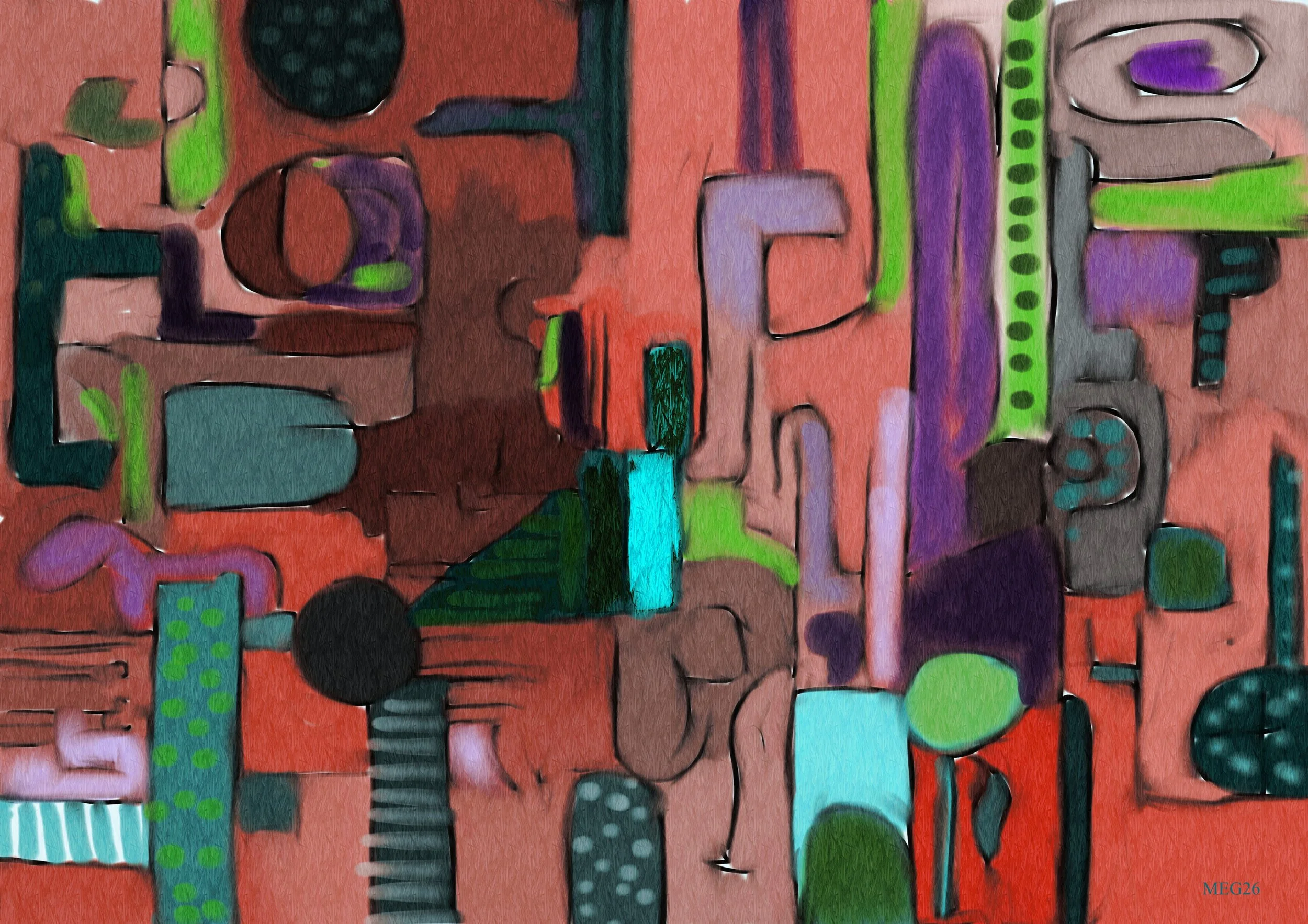
Meiko Georgouras, Red Fugue, 2026
One of the questions artists are most often asked is, "What does it mean?" The question seems straightforward enough, yet many artists have resisted answering it directly. Not because they are being elusive, but because they understand that the work itself is often the most complete answer they can offer.
I was reminded of this recently while reading about the current exhibition of painter Rita Ackermann at Hauser & Wirth in New York. Ackermann speaks of painting as a process of discovery rather than explanation. The more one attempts to define a work in words, the more one risks moving away from the experience that the work itself creates. Language can illuminate, but it can also limit. A painting operates through colour, rhythm, balance, intuition, memory and sensation. Its meaning often lies precisely in those things that words struggle to capture.
This thought feels particularly relevant when considering Scroll Variations, the new series of digital paintings by Meiko Georgouras.
For Meiko, the question of explanation carries a particular significance. Living with a disability that limits verbal communication, Meiko has long relied on visual art as the primary means through which ideas, observations and emotional experiences are expressed. The paintings do not accompany a spoken narrative; they are the narrative. Rather than explaining the work through language, Meiko speaks through colour, form and composition.
Developed from the original Scroll series of 2019, Scroll Variations revisits earlier motifs and structures, transforming them through contemporary digital processes. Inspired in part by the abstract innovations of Wassily Kandinsky, the series explores movement, repetition and change. Forms migrate from one image to another. Colours reappear in altered relationships. Suggestions of landscape, architecture, horses, music and memory emerge and dissolve. The works evolve through variation rather than description.
Looking across the series, one senses a visual conversation taking place. A shape appearing in one work may return transformed in another. A colour that dominates one composition becomes a subtle accent in the next. The paintings carry traces of previous works while continually generating new possibilities. They are connected not by a fixed narrative but by an unfolding visual logic.
Perhaps for this reason, Scroll Variations invites a different kind of viewing. Rather than searching for a definitive interpretation, the viewer is encouraged to spend time with the paintings and allow meanings to emerge gradually. The works ask to be experienced rather than decoded. They reward attention to rhythm, colour, balance and movement. Like music, they communicate through relationships rather than statements.
In this sense, the exhibition embodies the paradox that Ackermann describes. The more we try to explain a painting, the further we may move from its essential experience. Meiko's works remind us that art possesses its own language, one capable of expressing ideas that exist before words and beyond them.
Scroll Variations is not an exhibition about finding answers. It is an invitation to look, to pause and to encounter what the paintings themselves have to say.
2026
*Hauser & Wirth , 'Rita Ackermann. The Chemical Alphabet', New York, NY
American Art Catalogues, 'Rita Ackermann. Sketchbooks & Drawings, 2019 –2026', New York NY
“If you define something, what something is, it is no longer that something.
My preference is not to talk about or put words to my work.
It either works for you or doesn’t work for you and me explaining it isn’t going to make it work for you.”