Why Looking at Art Matters: Encountering Other Minds in a Gallery
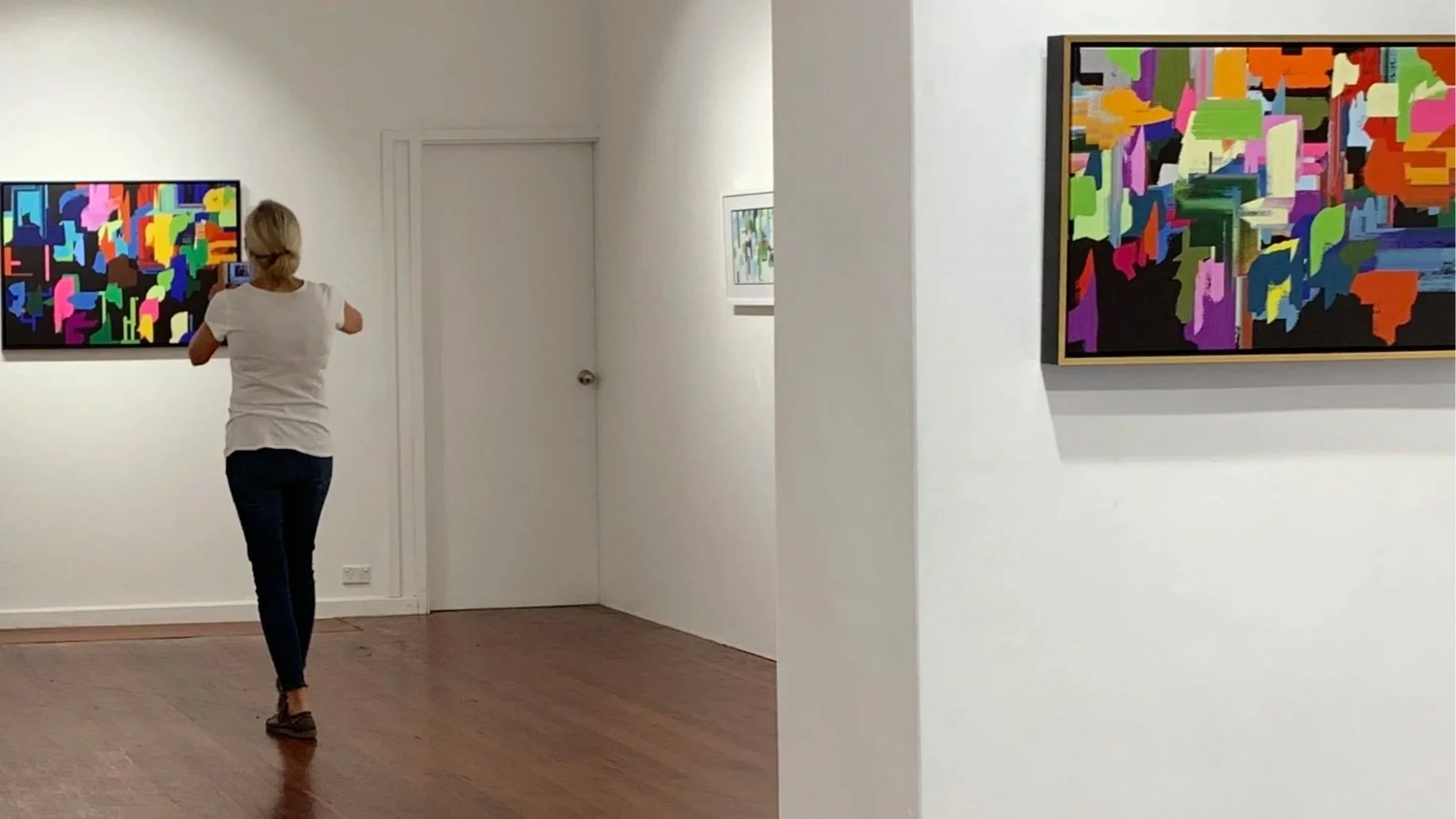
A person viewing Meiko Georgouras’ Scroll exhibition from 2019
Art as a Meeting Between Minds
When we look at a work of art, something unusual happens. We are not simply looking at colour, form, or subject matter—we are looking into another mind. Every artwork is the visible trace of a consciousness. Behind every line, colour, and compositional decision lies an act of attention: a person deciding what matters, what should be emphasised, and what should disappear. A painting, drawing, or digital image becomes a record of these decisions. To stand before a work of art is therefore to encounter the structure of another person’s perception.This is one reason art galleries have always held such fascination. Moving through a gallery is not only a visual experience; it is an encounter with many different ways of seeing the world. Each work represents a particular mind organising experience into form. One artist may construct a calm geometry of colour and space, while another pursues movement, tension, or psychological intensity. As viewers move from one work to another, they pass through a series of distinct mental landscapes.
The Unique Experience of Viewing Visual Art
Unlike literature or music, visual art offers this encounter almost instantly. A novel unfolds over time, and music must be heard sequentially. A painting or drawing presents its structure all at once.In a single glance we begin to sense the rhythm of lines, the balance of shapes, and the emotional weight of colour. Even before we consciously analyse what we are seeing, we intuit the artist’s ordering of the world.Looking at art therefore becomes a form of discovery. We are not only discovering images—we are discovering perspectives. Each artwork quietly asks the viewer a question: What does the world look like through this mind?
Physical Galleries and the Experience of Slow Looking
Traditional galleries and museums are designed to support this encounter. As we move through their rooms, we pause where something draws our attention. The artwork becomes a meeting point between two forms of awareness: the consciousness that created the work and the consciousness that receives it. This act of looking is rarely passive. The viewer participates in reconstructing the artist’s thinking. Our eyes follow the movement of a brushstroke or the tension between colours. Gradually the internal logic of the artwork begins to emerge. When this happens, the gallery becomes more than a display of objects. It becomes a space where perception itself is explored.
Online Art Galleries and the Expansion of Viewing
Online galleries have expanded this experience in remarkable ways. Today, viewers can explore collections and discover artists from anywhere in the world. Although the physical presence of an artwork changes when viewed on a screen, something essential remains intact. The visual language of the work—the arrangement of form, colour, and composition—still carries the imprint of the artist’s perception. Browsing an online gallery often mirrors the experience of walking through an exhibition. One image leads to another. We pause, enlarge a detail, move on, and then return. Gradually certain works begin to stand out. Something about the artist’s way of seeing resonates with our own. You can experience this process yourself by exploring the works currently available in the Thomas-Georgouras Studios online gallery: https://www.thomas-georgourasstudios.au/shop
Why Viewing Art Is as Important as Making It
For this reason, looking at art is just as important to human culture as creating it. The artist begins the exchange, but the viewer completes it. Without the attentive eye of the viewer, the visual language of the artwork remains silent. It is through looking that the conversation between minds becomes active. The viewer’s perception meets the artist’s perception, and something new emerges between them. This subtle exchange is also what lies at the heart of collecting art. When someone chooses to live with an artwork, they are not simply choosing an image—they are choosing an ongoing relationship with the way another mind has seen the world. Collectors often describe this experience in simple terms: certain works continue to draw them back. Over time the artwork becomes part of the rhythm of everyday life, quietly shaping how we notice colour, light, space, and memory.
A Bridge Between Consciousness
Perhaps this is why we continue to seek out galleries, exhibitions, and online collections. Beneath the colours and forms lies a deeper attraction: the opportunity to glimpse how another person has understood the world. In that moment of recognition, the artwork becomes more than an object. It becomes a bridge between minds. And each time we pause to look—whether in a quiet gallery space or while browsing an online collection—we step briefly beyond our own perspective and encounter the rich diversity of human perception.
Living With Art
This experience becomes even deeper when an artwork enters the space of everyday life. In a home or workplace, the act of looking is no longer brief or occasional. The artwork is encountered repeatedly—sometimes consciously, sometimes only in passing. Over time the viewer begins to notice new relationships within the work: a colour that seems different in morning light, a shape that draws attention after months of familiarity, a mood that reflects or alters the atmosphere of the room. The artwork continues to reveal the artist’s way of seeing long after the first encounter. For many collectors, this is the true value of art. A work chosen carefully becomes part of the visual rhythm of daily life, quietly extending the conversation between the artist’s perception and the viewer’s own awareness.