The Architecture of Survival: Disability, Thought and the Reassembly of Perception
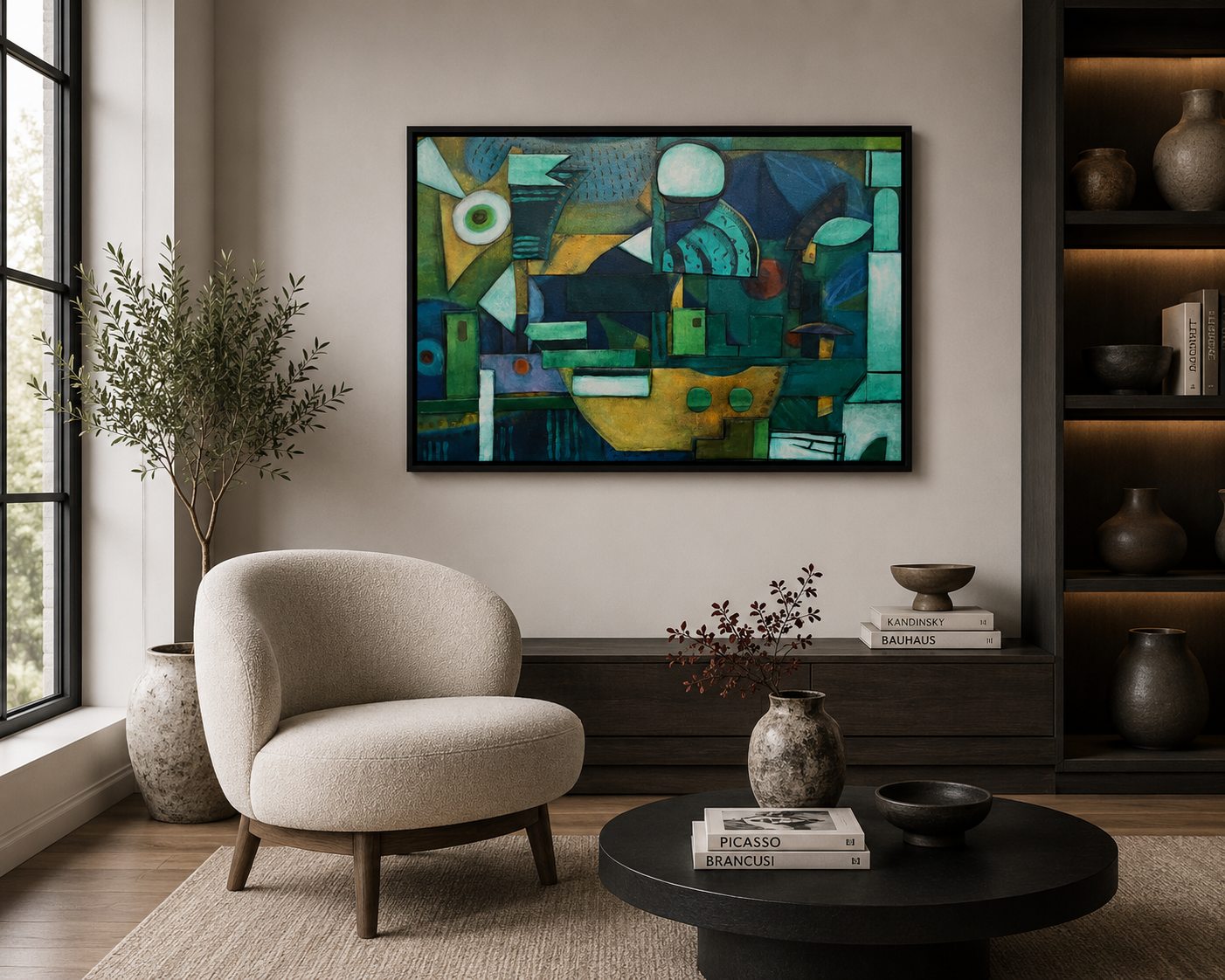
Meiko Georgouras, “Form 7”, 2026
In philosophy, the term architectonic refers to the systematic organisation of knowledge into a coherent structure. Immanuel Kant used the word to describe the way human understanding attempts to build order from the fragmented experiences of existence. Architectonics is not simply architecture in a physical sense; it is the architecture of thought itself — the framework through which perception, memory, emotion and reason are assembled into a meaningful whole.
In contemporary life, this idea has become increasingly relevant. Human experience is often fractured by trauma, illness, instability, information overload and emotional dislocation. Thought itself can become fragmented. Under these conditions, survival is not merely physical endurance, but the ability to reconstruct an inner structure capable of holding experience together without collapsing beneath it.
This is where art can become more than representation. It can become a form of cognitive and emotional architectonics.
Meiko Georgouras’ Forms series operates within this space. Through layered acrylic and collage, the paintings create systems of interconnected forms that behave like maps of consciousness in motion. Fragments of colour, geometric divisions, interrupted pathways and organic structures coexist within dynamic fields of tension and balance. The works do not present a stable image for passive viewing; rather, they construct environments through which perception itself must move.
The collage process is central to this idea. Pieces are assembled, displaced, broken apart and reconfigured. This mirrors the way human beings often rebuild themselves psychologically after disruption. The mind rarely reconstructs itself as a seamless unity. Instead, it gathers fragments — memories, emotions, symbols, routines and perceptions — and slowly creates new systems of coherence. Architectonics, in this sense, becomes an act of survival.
Yet survival alone is not the endpoint. The deeper function of architectonic thought is the possibility of thriving through reorganisation. Once fragmentation is accepted as part of existence rather than as failure, new forms of perception become possible. Flexibility replaces rigidity. Connection replaces isolation. The self becomes less like a fixed monument and more like a living structure capable of adaptation and renewal.
Within the Forms series, this process is visible in the continual negotiation between order and instability. Linear frameworks suggest scaffolding, circuitry or structural grids, while fluid biomorphic forms move through and against them like emotional or biological forces. The paintings resist closure. They remain open systems — evolving networks where meaning is constantly reconstructed through relation.
This is particularly important in the context of disability, neurological difference and lived vulnerability. Traditional models of thought often privilege stability, efficiency and fixed coherence. But human cognition is rarely so uniform. Architectonic reconstruction allows for another possibility: that fragmented perception may itself generate new forms of insight, sensitivity and creative organisation. What appears broken can become the basis for entirely new structures of understanding.
The Forms paintings embody this principle visually. They are not images of defeat or restoration in any sentimental sense. Instead, they operate as living diagrams of adaptation. Colour becomes energy. Line becomes navigation. Fragmentation becomes structure. The paintings suggest that consciousness itself is not static but continuously assembling and reassembling its relationship to reality.
In this way, architectonics is not merely a philosophical concept. It becomes an existential practice — the ongoing work of building frameworks capable of sustaining meaning, imagination and life itself. Through abstraction and collage, Meiko Georgouras transforms this process into visual form, creating works that invite viewers to reconsider how perception, memory and resilience are constructed from within.
The Forms series ultimately proposes that thriving is not the achievement of perfect order, but the ability to continually reshape one’s inner architecture in response to the changing conditions of existence.