Passage Without Fear
The Book of Psalms has always occupied a singular place in human culture; not as doctrine, but as a companion. It does not argue its way into belief; it speaks from within experience. Across centuries, it has remained one of the few texts that meets people exactly where they are: in grief, in awe, in terror, in gratitude. It is not a linear theology but a cyclical one, returning again and again to the same elemental truth; that the passage through life, and ultimately through death, need not be governed by fear.
What makes the Psalms enduring is their emotional honesty. They do not conceal anguish or tidy suffering into resolution. Instead, they articulate the full spectrum of human vulnerability: abandonment, longing, despair, and fragile hope. In doing so, they provide something more powerful than answers; they offer language. And language, in moments of extremity, becomes a form of structure. To speak fear is already to begin moving through it.
Historically, the Psalms have accompanied individuals and communities at the threshold points of existence: exile, war, illness, mourning. They have been sung in temples, whispered at bedsides, carried into prisons, and recited in moments before death. Their persistence across time suggests not just religious significance, but psychological necessity. They function as a map; not of events, but of interior states. They chart a movement from fragmentation toward coherence, from isolation toward presence.
The Psalm Series enters into this lineage, not as illustration but as embodiment. These paintings do not depict biblical scenes; they translate the experiential core of the Psalms into visual form. Where the text gives voice, the paintings give structure to silence. They operate in the space before and beyond words; where fear, memory, and transcendence intermingle.
Across the series, the human figure often appears suspended between dissolution and emergence. Forms are fragmented, layered, and reconstituted, echoing the instability of identity under pressure. There is no fixed ground. Instead, fields of colour and line function as psychological terrains; at times turbulent, at times luminous. The compositions resist resolution, yet they do not collapse into chaos. There is always a counterforce at work: a rhythm, a pull toward integration.
This tension is crucial. The Psalms themselves do not eliminate fear; they transform the relationship to it. “I will fear no evil” is not a denial of danger, but a reorientation of perception. Fear becomes something that can be held within a larger field of meaning. The Psalm Series mirrors this shift. Darkness is present, often overwhelming, but it is never absolute. Light does not erase it; it coexists, pressing through, reconfiguring the space.
The context from which these works arise gives them additional weight. They are shaped by prolonged encounters with illness, care, and the gradual erosion of certainty. In such conditions, fear is not abstract; it is lived, daily, cumulative. The Psalms, in this light, are not distant texts but active companions. The paintings extend that companionship into a shared visual space, allowing others to enter into the same negotiation between vulnerability and endurance.
What emerges is not comfort in the sentimental sense, but something more durable: a recognition that fear can be carried without being definitive. The passage through life and death is not smoothed or simplified. It remains complex, often opaque. Yet within that complexity, there is the possibility of orientation; of finding a way to move, even when clarity is absent.
The enduring relevance of the Psalms lies precisely here. They do not promise escape from suffering. They offer a way to inhabit it without being consumed. The Psalm Series takes up that task in another medium, translating ancient rhythms into contemporary form. Together, they suggest that the deepest human need is not certainty, but accompaniment; the sense that even in the most disorienting passages, one is not entirely alone.
And perhaps this is what allows fear to loosen its hold. Not because it disappears, but because it is met—spoken, seen, and carried—across time, across bodies, across forms.
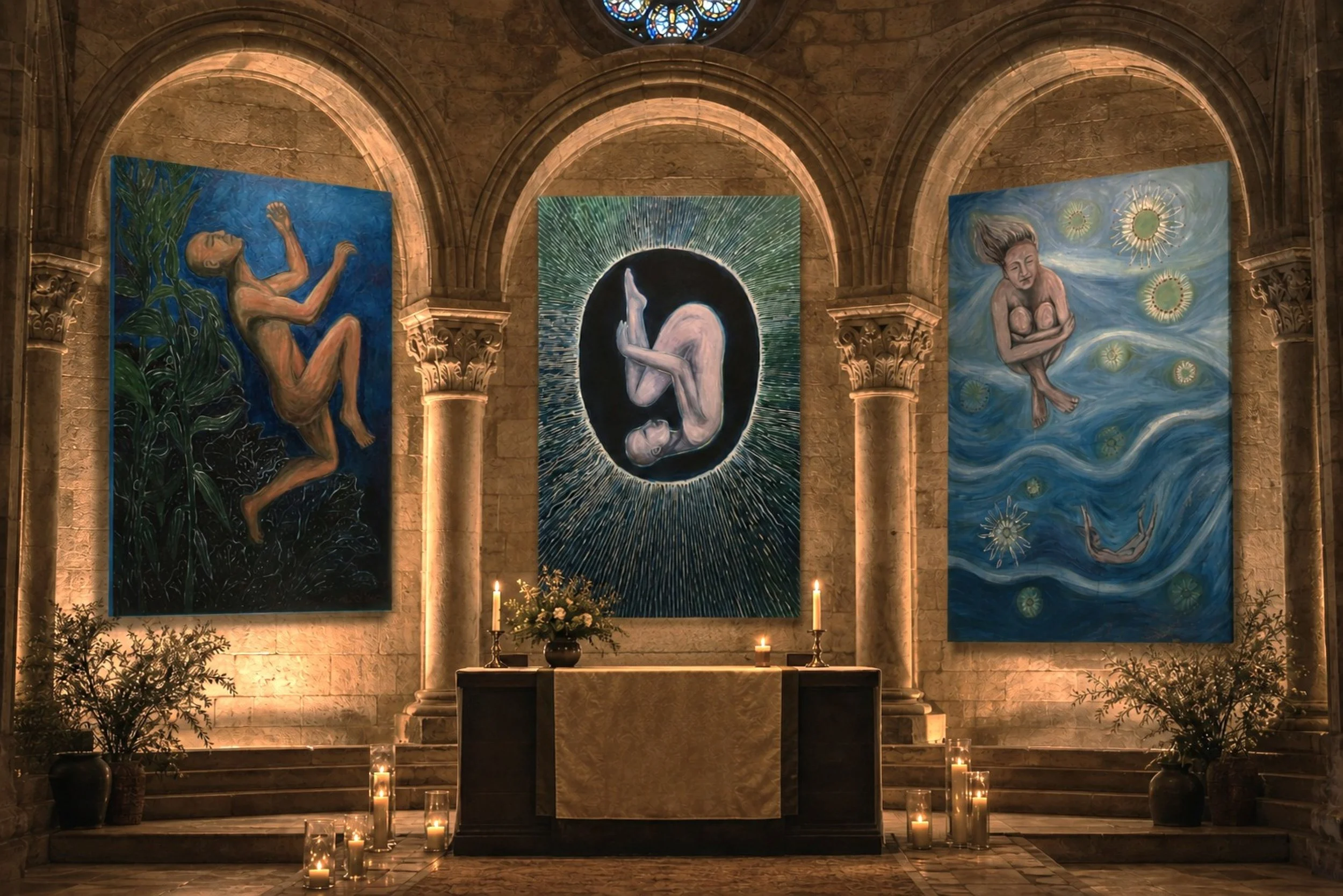
Psalm Series in a Sacred Space